
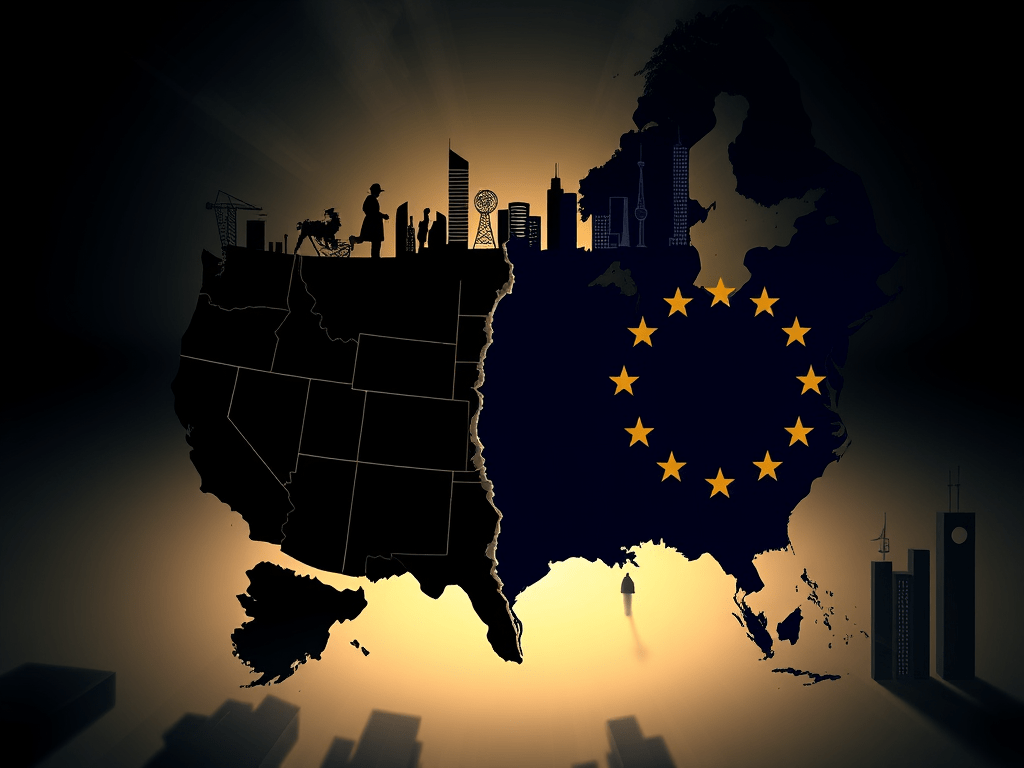
In an unusually blunt assessment, the latest commentary by Axel D. Angermann, Chief Economist, FERI Group, highlights a striking imbalance in transatlantic trade relations and issues a call to action for Europe’s political leadership. “The obvious weakness of the EU offers opportunities,” Angermann notes — an opening line that sets the tone for a piece that is as much a critique as it is a roadmap for resilience.
At the center of his analysis is a newly signed trade deal between the United States and the European Union. While framed as a bilateral agreement, the outcome heavily favors American interests: U.S. companies will enjoy tariff-free access to EU markets, while European exports to the U.S. will be subject to tariffs of up to 15%. “A trade deal that benefits only the U.S. once again highlights the EU’s self-inflicted weakness,” Angermann writes.
While the European Commission may have had little room to negotiate more favorable terms, the consequences for EU-based companies are real and immediate. Many firms will be forced to absorb the added cost — and some may consider shifting production to the U.S. to sidestep the new tariffs. But for most, such a move is neither feasible nor economically sound. Angermann argues that the only sustainable solution lies in “necessary productivity increases to defend competitiveness — and these are achievable.”
To support this claim, he draws a historical parallel. For decades, German industry thrived not because of favorable exchange rates, but in spite of them. The strength of the Deutsche Mark, underpinned by the Bundesbank’s strict stability-oriented monetary policy, created constant pressure on exporters to innovate and improve productivity. This pressure, Angermann argues, forged a globally competitive industrial base — aided by a political environment that provided a supportive framework.
That precedent, he says, is relevant again today.
Subscribe to get access
Read more of this content when you subscribe today.
But advantages on paper mean little without political will. “Political action is necessary — and this insight must be followed by far greater speed and decisiveness in implementation,” he urges. A clear path forward already exists in the form of the Draghi Report and other recent recommendations. Yet policy execution remains sluggish.
Angermann singles out the proposed EU budget revision as a test case. While welcoming the European Commission’s intention to reallocate spending towards competitiveness, he is critical of the timeline. “It would have been far more appropriate to say, Trump-style: we’re not waiting until 2028 — we’re doing this now. Let’s reach an agreement this autumn and implement the new budget by January 2026.” Such an approach, he argues, would demonstrate both urgency and capability.
And perhaps, he suggests, that is the paradoxical benefit of this lopsided trade deal: it may finally compel Europe to act with the clarity and resolve that global competition demands. “If the deal that forced the EU to submit to Trump leads to a change in approach, Europe might ultimately benefit from it.”











 ^^^ RATING EVIDENCE GmbH
Leave a comment