
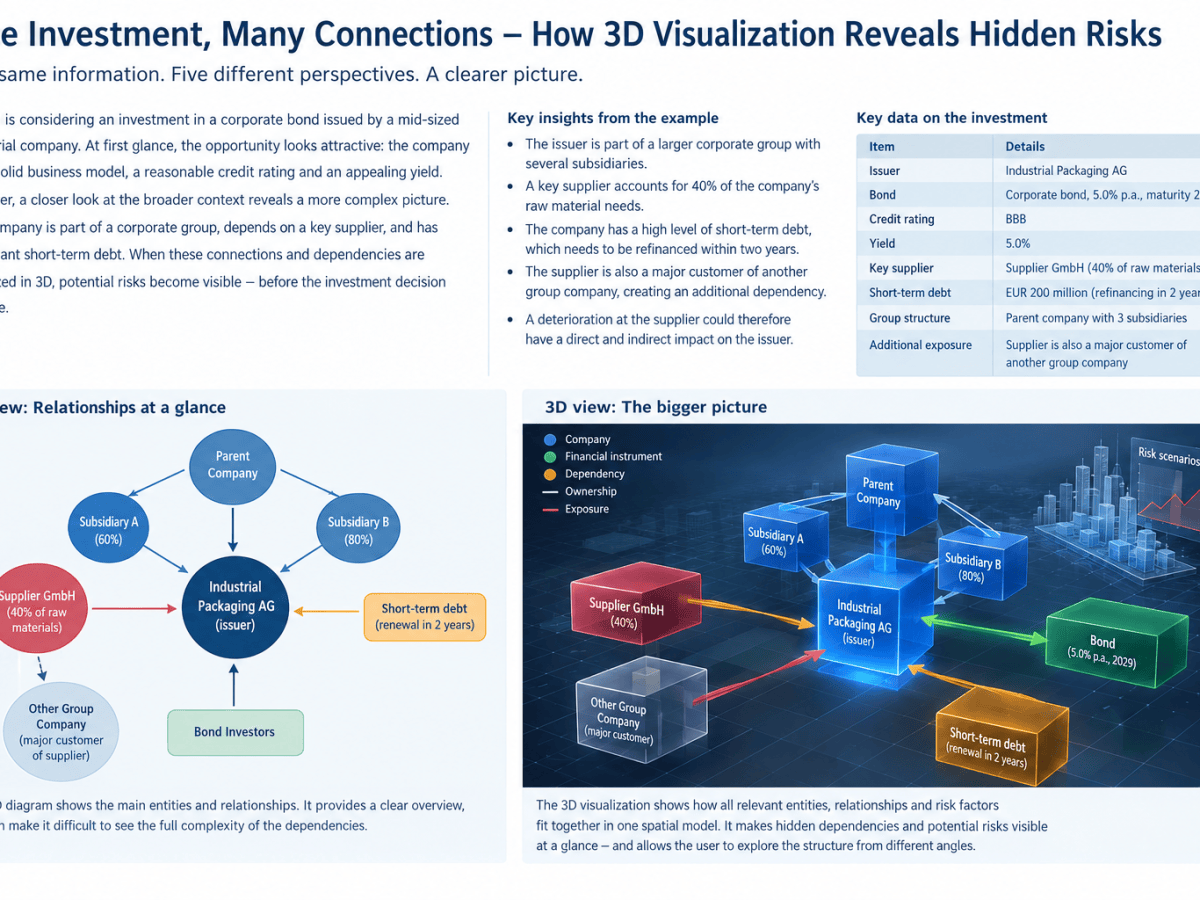
From Data Presentation to Spatial Understanding: Why Financial Analysis Achieves Its Highest Insight Potential in Immersive 3D Environments
Financial information can be presented in many different ways. A financial analyst can describe a situation in prose, summarize its characteristics in a list, organize its components in a table, or illustrate relationships in a two-dimensional diagram. Each representation has its own advantages, and each can communicate important aspects of a financial decision. Yet when…

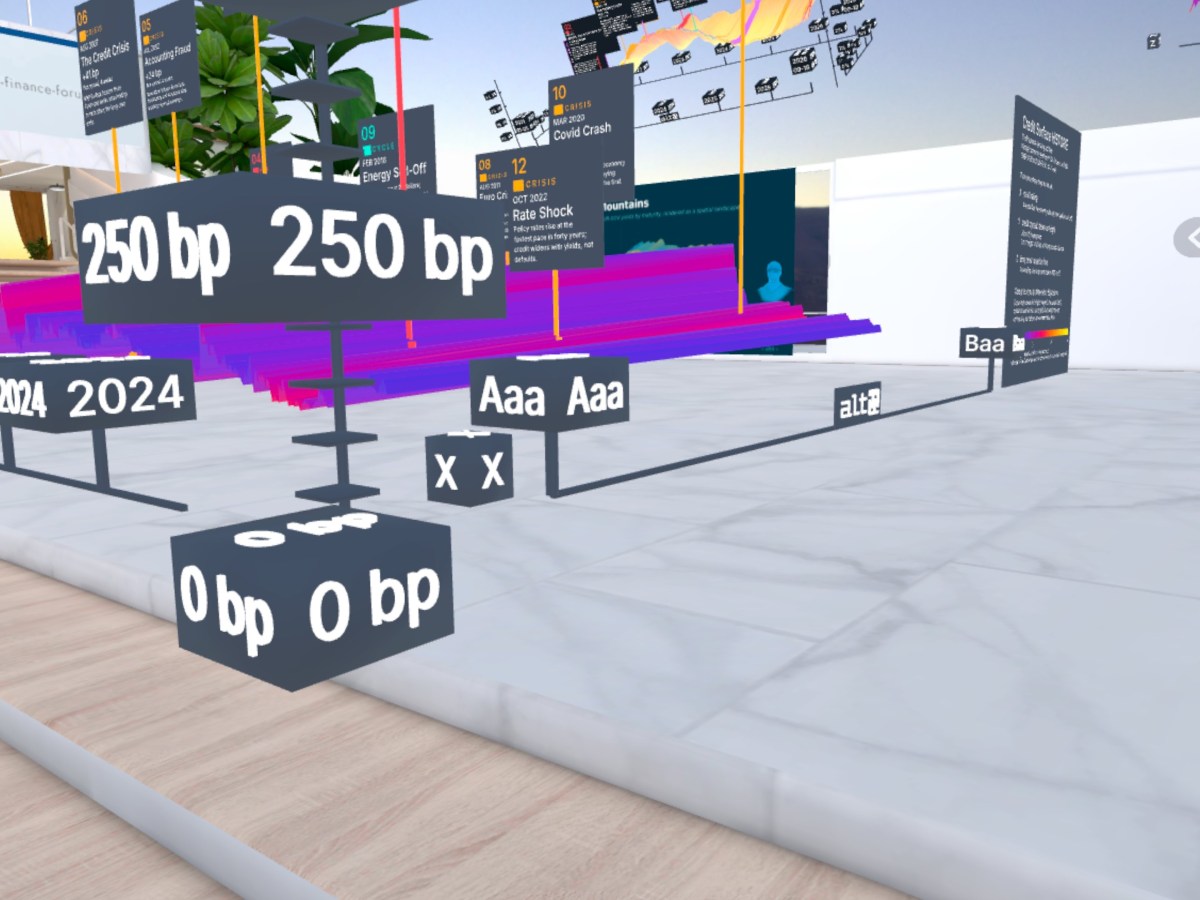
Immersive Finance: Making Credit Risk Visible in Three Dimensions
How can credit ratings become easier to understand, explain and challenge? The Immersive Finance Forum on 13 October 2026 demonstrated how spatial computing can transform complex financial data into interactive three-dimensional environments. Under the title “Walking Through Markets, Telling Fund Stories,” participants explored new ways to visualize market risks, credit spreads and investment histories in…

ESG Ratings in Transition: Why Transparency, Artificial Intelligence and Human Judgment Must Go Hand in Hand
The European regulation of ESG rating providers marks an important milestone in the development of sustainable finance. As Julia Haake, Chief Revenue Officer at EthiFinance and Chairwoman of the European Association of Sustainability Rating Agencies (EASRA), explains, the new regulatory framework increases the importance of transparency, methodological rigor and reliable data. From the perspective of…

From Linear AI Conversations to Spatial Intelligence: How Data2Space Is Rethinking Human–AI Interaction
Beyond the Chat Window Artificial intelligence has made it possible to explore complex questions, analyze large amounts of information, and generate ideas at unprecedented speed. Yet the way people interact with AI has changed surprisingly little. Most systems still present their results in a linear sequence of messages, forcing users to navigate a conversation history…

When AI Disrupts the Economy: Why Investors Need a New Model of Evidence
Artificial intelligence is no longer simply a technology story. It is increasingly becoming an economic story — with potentially profound consequences for productivity, employment, corporate structures, competitive advantage and the allocation of capital. In a recent assessment, rating agency Egan-Jones takes an unusually definitive position. Its conclusion is striking: “AI has advanced so far that…

Experience Finance in a New Dimension
How can complex financial information be communicated in a way that it is not merely seen, but immediately understood and experienced? This is the central question addressed by the Immersive Finance Forum (iff), a series of events exploring the potential of virtual reality, 3D visualization and immersive communication in finance. The next event takes place…

Moody’s Takes a Stake in PhilRatings: A Sign of the Philippine Bond Market’s Growing Importance
Moody’s Corporation’s decision to acquire a minority stake in Philippine Rating Services Corporation (PhilRatings) is more than a transaction between two credit-rating organizations. It is a strategic signal about the increasing importance, sophistication and international relevance of the Philippine debt capital market. Moody’s announced on September 14, 2026 that it had agreed to acquire a…

A spectacular finding from Jan F. Wagner’s investigation
Jan F. Wagner’s investigation into Scope, published in the September edition of Bankmagazin by Springer Professional under the title “Die Reifeprüfung von Scope”, draws attention to a side of the European rating agency that stands in sharp contrast to its recent strategic successes. Jan F. Wagner’s investigation may therefore have raised a question that is…

