

Beyond the Chat Window
Artificial intelligence has made it possible to explore complex questions, analyze large amounts of information, and generate ideas at unprecedented speed. Yet the way people interact with AI has changed surprisingly little. Most systems still present their results in a linear sequence of messages, forcing users to navigate a conversation history to reconstruct relationships between ideas.
This interface is convenient for individual questions, but it becomes increasingly restrictive when a subject requires sustained investigation. A strategic decision, an investment opportunity, or a scientific problem rarely consists of a single question followed by a definitive answer. Instead, understanding develops through successive inquiries, comparisons, hypotheses, and discoveries.
The next step in human–AI interaction may therefore be to change not only what AI produces, but also where and how its results become accessible to human thinking.
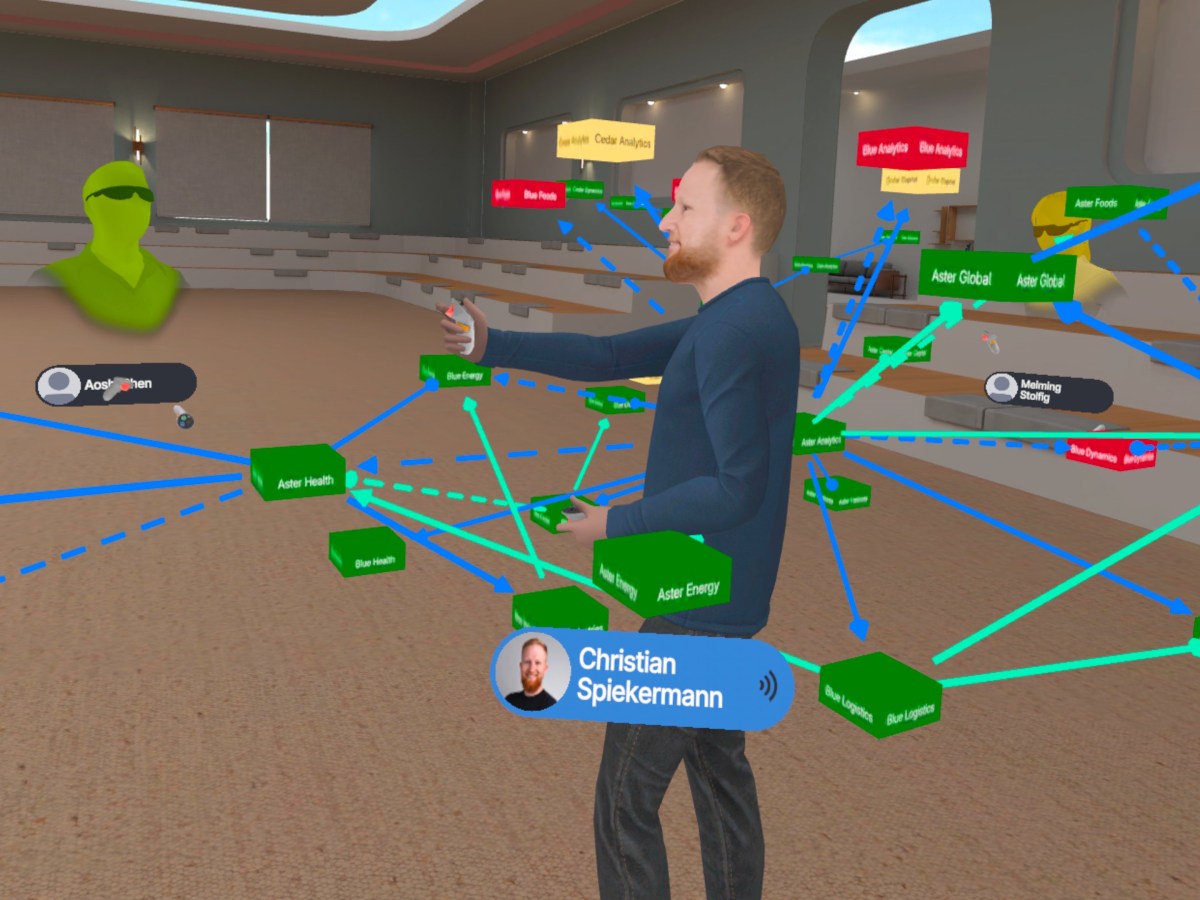
Extended Reality (XR), encompassing virtual, augmented, and mixed reality, provides an opportunity to transform AI-generated information into a spatial environment. Instead of reading successive answers on a screen, users could place them around themselves, connect them to previous findings, and explore the resulting structure from different perspectives.
This would turn an AI conversation into a persistent environment for thinking. Information would no longer exist exclusively in a chronological sequence. It could occupy meaningful positions in three-dimensional space, allowing users to revisit individual answers and understand their relationships to the broader subject.
Data2Space is exploring approaches to making this vision a practical reality by combining AI-driven inquiry with spatial visualization. The ambition is to create environments in which knowledge develops dynamically as users ask questions, examine answers, and discover new connections.
The Knowledge Tree: A New Architecture for Thinking
A useful starting point is the metaphor of a tree.
A central question forms the trunk. Its principal answers develop into major branches, while subsequent questions and answers create smaller branches and leaves. Related branches can connect to one another, forming a network that reflects the complexity of the subject being investigated.
The tree is not intended merely as a decorative representation. It provides an organizing principle for a growing body of information.
Consider a user investigating the future of artificial intelligence in financial services. The initial question might generate several principal branches:
- Technology: Which AI capabilities are becoming commercially viable?
- Economics: How will automation affect costs, productivity, and profitability?
- Competition: Which companies are best positioned to benefit?
- Risk: What new operational, regulatory, and financial risks might emerge?
- Investment: Which opportunities offer an attractive relationship between risk and expected return?
Each branch can generate further questions. An investigation into productivity, for example, might lead to questions about employment, operating margins, competitive pricing, and capital requirements.
These answers become additional spatial elements. The user can move closer to a particular branch to investigate its details, step back to see the larger structure, or follow connections into another area.
The resulting environment resembles a tree whose branches grow in response to intellectual exploration. Unlike a conventional mind map created manually after a discussion, this structure could evolve continuously as AI generates answers and proposes further avenues of inquiry.
The essential principle is that the spatial organization should reflect the intellectual organization of the subject.
A random collection of floating text panels would offer little advantage over a conventional screen. A meaningful spatial structure, by contrast, could help users recognize hierarchies, dependencies, contradictions, and connections between apparently unrelated concepts.
How AI and XR Can Work Together
AI and XR contribute different capabilities to this process.
AI can generate explanations, identify relevant information, propose questions, summarize discussions, and suggest relationships between existing findings. XR provides the spatial environment in which these elements can be arranged, explored, and remembered.
Human judgment remains essential. Users decide which questions matter, evaluate the reliability of answers, and determine whether suggested connections make sense.
The interaction can be understood as a continuous cycle:
- Ask: The user poses an initial question to the AI.
- Visualize: The answer appears as a text element in a meaningful spatial position.
- Explore: The user selects an answer and investigates its implications.
- Expand: Further questions generate new answers and additional branches.
- Connect: Related findings are linked across different branches.
- Evaluate: The user examines evidence, uncertainties, contradictions, and alternative explanations.
- Remember: The evolving environment is saved so that the investigation can be resumed later.
This process changes the role of AI from a provider of isolated responses into a participant in a continuous process of knowledge development.
The spatial environment becomes a persistent representation of the investigation, preserving not only its conclusions but also the questions, assumptions, and relationships that led to them.
| Capability | Conventional AI chat | Spatial AI environment |
|---|---|---|
| Information structure | Primarily chronological | Spatial, hierarchical, and interconnected |
| Follow-up questions | Extend the conversation | Expand the relevant branch of knowledge |
| Relationships between answers | Must often be reconstructed mentally | Can be represented through visible connections |
| Navigation | Search or scroll through messages | Move between spatially arranged concepts |
| Overview | May require reviewing conversation history | Can be provided by the overall structure |
| Knowledge continuity | Depends on conversation history and memory features | Can be supported by persistent spatial arrangements |
| Collaboration | Primarily through shared conversations or documents | Potentially through shared, explorable knowledge environments |
Spatial environments would not automatically outperform conventional chat in every situation. A simple factual question may be answered more efficiently in a traditional interface. The advantage emerges when users need to investigate a complex subject over time, maintain an overview, and understand how multiple lines of reasoning interact.
Spatial Memory as an Additional Cognitive Resource
The human brain has evolved to navigate environments, recognize landmarks, and remember the relative positions of objects. These capabilities contribute to the way people organize and retrieve information.
Research on spatial cognition and the use of spatial mnemonics, including the method of loci, demonstrates that spatial structure can support certain forms of memory. XR creates an opportunity to apply related principles to the organization of AI-generated knowledge.
Imagine returning to a research project after several weeks. Instead of searching through hundreds of messages, the user enters the saved environment and recognizes the principal branches. The financial analysis remains in one area, the technological assessment in another, and the regulatory discussion at a third location.
A particular answer may be easier to recall because the user remembers its position relative to other information.
This does not mean that spatial placement automatically improves memory or guarantees deeper understanding. The effectiveness of such environments will depend on their design, the user’s engagement, the complexity of the material, and the way information is organized.
Nevertheless, spatial arrangements could provide an additional set of cues for remembering and retrieving knowledge.
The objective is not simply to display information in three dimensions, but to use space as an active component of the thinking process.
From Answers to Questions That Have Not Yet Been Asked
Perhaps the most important opportunity lies in the generation of new questions.
When users examine a spatial structure, they can see not only the information already collected but also the relationships between different areas of investigation. This may reveal gaps, dependencies, and contradictions that remain difficult to identify in a linear conversation.
Subscribe to get access
Read more of this content when you subscribe today.
Such questions arise from relationships between previously separate lines of inquiry.
AI could actively support this process by suggesting:
- Connections between answers generated at different stages of an investigation.
- Missing questions that could materially change a conclusion.
- Contradictions between assumptions or findings.
- Alternative scenarios that challenge the current line of reasoning.
- Evidence needed to validate or reject a hypothesis.
- Links between the current investigation and knowledge accumulated in earlier projects.
The user would not need to anticipate every relevant question at the beginning. The investigation could evolve as new relationships become visible.
This approach could be particularly useful in research, strategic planning, due diligence, investment analysis, and other activities where the quality of a decision depends on examining the problem from multiple perspectives.
Applications in Investment and Financial Analysis
For Data2Space, the combination of AI and XR has particular relevance to investment and financing decisions.
Financial analysis frequently requires the integration of information from different domains. A company’s creditworthiness, for example, depends not only on its financial statements but also on its business model, market position, management, competitive environment, and exposure to external risks.
These factors are interconnected. A change in technology may affect a company’s competitive position, which in turn influences revenue growth, margins, capital expenditure, and debt-servicing capacity.
A spatial knowledge environment could make these relationships easier to explore.
An initial question about an investment opportunity could generate branches covering:
- Business model and value creation.
- Market size and competitive dynamics.
- Financial performance and capital structure.
- Management quality and governance.
- Technological opportunities and dependencies.
- Regulatory requirements and external risks.
- Valuation, financing options, and exit scenarios.
Further questions could expand individual branches while preserving links to the rest of the analysis.
The resulting structure could help analysts identify dependencies that might otherwise remain hidden within separate reports and spreadsheets.
For credit rating professionals, the approach could also support the examination of assumptions behind a rating assessment. Analysts could navigate from a rating conclusion to the underlying evidence, from the evidence to the relevant assumptions, and from those assumptions to alternative scenarios.
However, spatial visualization would complement rather than replace established analytical methods. Financial calculations, source verification, documented rating methodologies, and independent judgment would remain indispensable.
The potential advantage lies in making complex relationships more accessible and enabling analysts to explore the implications of their assumptions more systematically.
Data2Space: Turning the Vision into a Practical Environment
Realizing this concept requires more than placing AI-generated text panels in a virtual room. The environment must support meaningful organization, intuitive navigation, persistent storage, and the continuous expansion of knowledge.
Data2Space is pursuing approaches that combine AI-driven question-and-answer processes with spatial visualization to address these requirements.
The aim is to enable users to build a structured environment in which information is not simply accumulated but organized according to its meaning and its relationships with other information.
Several design principles are particularly important.
First, spatial order must remain intelligible. A tree-like arrangement can provide a natural hierarchy, but the system must prevent excessive branching from overwhelming the user.
Second, the environment must preserve context. Each answer should remain connected to the question that generated it, while important relationships to other answers should also be visible.
Third, the system must support progressive exploration. Users should be able to move between a high-level overview and detailed investigations without losing their orientation.
Fourth, the environment must remain persistent. A saved spatial structure should enable users to resume their work, revisit previous reasoning, and integrate new information into an existing knowledge base.
Fifth, AI-generated content must remain verifiable. Users need to distinguish sourced information from assumptions, hypotheses, and AI-generated interpretations.
These principles are essential if spatial AI is to become a practical tool for serious intellectual work rather than an impressive but temporary visualization.
The Challenges: Complexity, Trust, and Cognitive Overload
The opportunities are substantial, but several challenges remain.
A large investigation can generate thousands of answers and relationships. Without intelligent grouping, summarization, and filtering, the environment could become as difficult to navigate as an unstructured document archive.
The system must therefore decide when to create a new branch, when to connect information to an existing branch, and when to summarize a collection of related findings.
Another challenge concerns the distinction between a meaningful connection and a merely plausible one. AI may identify relationships that deserve investigation but are not supported by sufficient evidence. A visually prominent connection could inadvertently give a speculative hypothesis more credibility than it deserves.
The interface should consequently distinguish between established findings, inferred relationships, open questions, and unresolved contradictions.
There is also a human-factors question: how much spatial complexity can users comfortably manage? More dimensions do not necessarily mean better understanding. Some users may prefer a compact overview, while others may benefit from exploring detailed structures in three-dimensional space.
The most effective systems will likely combine multiple representations, allowing users to switch between conventional text, structured diagrams, and immersive spatial environments according to the task.
Finally, organizations using such environments will need to consider data protection, access rights, confidentiality, and the governance of shared knowledge. These issues become particularly important when the environment contains commercially sensitive information or supports financial decisions.
Toward a New Interface for Human Intelligence
The broader significance of spatial AI extends beyond any individual application.
For decades, digital interfaces have largely presented knowledge through documents, lists, tables, and windows. AI has greatly expanded the ability to generate and analyze information, but its outputs are still commonly delivered through these established formats.
XR offers an opportunity to reconsider the relationship between information and the human mind.
Instead of treating knowledge as a stream of messages, a spatial interface can represent it as an environment that people explore. Instead of requiring users to reconstruct every relationship mentally, it can make selected relationships visible. Instead of ending with an answer, an AI-supported investigation can continue by generating new questions and extending an existing structure.
In this model, the computer becomes more than a tool for retrieving information. It becomes an environment for developing and examining ideas.
Data2Space is exploring how this shift can be applied to the practical challenges of understanding complex information, particularly in investment and financing.
The long-term vision is an environment in which people and AI jointly develop a persistent, explorable structure of knowledge. The user asks questions, AI proposes answers and connections, and the spatial environment makes the evolving body of knowledge accessible to human perception and memory.
The ultimate objective is not to create the largest possible forest of text. It is to make the forest understandable: to help users recognize its structure, follow its branches, discover connections, and return to important insights when they are needed.
The next generation of AI interfaces may not be defined solely by how intelligently a machine answers a question, but by how effectively it helps people ask the next question, understand the answer, and connect it to everything they already know.
















Leave a Reply