

Artificial intelligence is no longer simply a technology story. It is increasingly becoming an economic story — with potentially profound consequences for productivity, employment, corporate structures, competitive advantage and the allocation of capital.
In a recent assessment, rating agency Egan-Jones takes an unusually definitive position. Its conclusion is striking: “AI has advanced so far that we regard the complete disruption of the economy as a near certainty.” According to the agency, AI is already taking charge of substantial parts of knowledge work, while human input and ingenuity are becoming less important in the production process.
Whether one agrees with the full extent of this conclusion or not, the underlying observation deserves serious attention. The question is no longer whether AI will affect the economy. The more consequential question is how rapidly AI capabilities will translate into changes in economic structures — and whether investors, risk managers and financial institutions are equipped to understand those changes.
From technological progress to economic disruption
Previous waves of automation primarily affected physical production or highly repetitive administrative tasks. The current generation of AI is different in one crucial respect: it increasingly operates in areas traditionally associated with human cognitive capabilities.
Writing, programming, research, analysis, customer communication, documentation, design and increasingly complex forms of decision support can all be augmented or partially automated by AI systems.
Egan-Jones argues that the latest models have crossed an important threshold. Their outputs are not merely technically impressive; they are becoming sufficiently useful, fast and accessible to support widespread adoption. This distinction matters.
A technology can be powerful without being economically transformative. Economic disruption occurs when technological capability becomes sufficiently reliable, affordable and scalable to change how organizations actually operate. That transition may already be underway.
The investment problem is becoming more complex
For institutional investors, the implications extend far beyond identifying companies developing AI. The more fundamental challenge is understanding how AI changes the assumptions underlying traditional financial analysis.
Consider a company whose competitive advantage has historically depended on a large workforce of highly skilled knowledge workers. If AI can substantially increase the productivity of those employees — or eventually perform significant parts of their work — several traditional assumptions may change simultaneously.
- Revenue growth may accelerate.
- Operating margins may expand.
- Cost structures may change.
- Capital requirements may decline.
- The relationship between headcount and output may weaken.
- Barriers to entry may fall in some markets while rising dramatically in others.
- And the economic value of intellectual property, organizational knowledge and human expertise may need to be reassessed.
The result is an investment environment in which historical financial statements may provide less information about future economic structures.
The speed of change creates a new risk
Financial markets are accustomed to uncertainty. Investors routinely deal with changing interest rates, commodity prices, geopolitical developments, regulation and business cycles. AI introduces another variable: the potential speed of technological change.
If AI capabilities improve incrementally, conventional forecasting frameworks may remain reasonably effective. But if capabilities improve rapidly and adoption follows quickly, historical relationships can become unreliable. This creates a distinctive form of model risk.
A financial model can be mathematically sophisticated and still produce misleading results if the economic assumptions underlying the model are changing faster than the model can incorporate them. For institutional investors and risk managers, therefore, the challenge is not simply to forecast better. It is to recognize when the forecasting framework itself is becoming obsolete.
From data abundance to evidence quality
This is where another transformation becomes important.
Financial institutions already possess extraordinary amounts of data. Market data, company filings, alternative data, macroeconomic indicators, satellite imagery, transaction data and increasingly AI-generated analysis can produce enormous quantities of information.
But more information does not automatically produce better decisions.
The bottleneck increasingly lies between information and understanding.
An investment committee may have access to thousands of pages of research, hundreds of financial indicators and sophisticated quantitative models. Yet the central question remains:
Can decision-makers rapidly understand what the information means, how the variables interact and where the critical risks are?
This is particularly important in an environment characterized by structural economic change.
Why visualization becomes strategically important
Traditional financial communication is predominantly two-dimensional.
Charts, dashboards, spreadsheets and reports are extremely effective for many analytical tasks. But complex systems can become difficult to understand when relationships between dozens or hundreds of variables need to be considered simultaneously.
Immersive visualization offers a different interface.
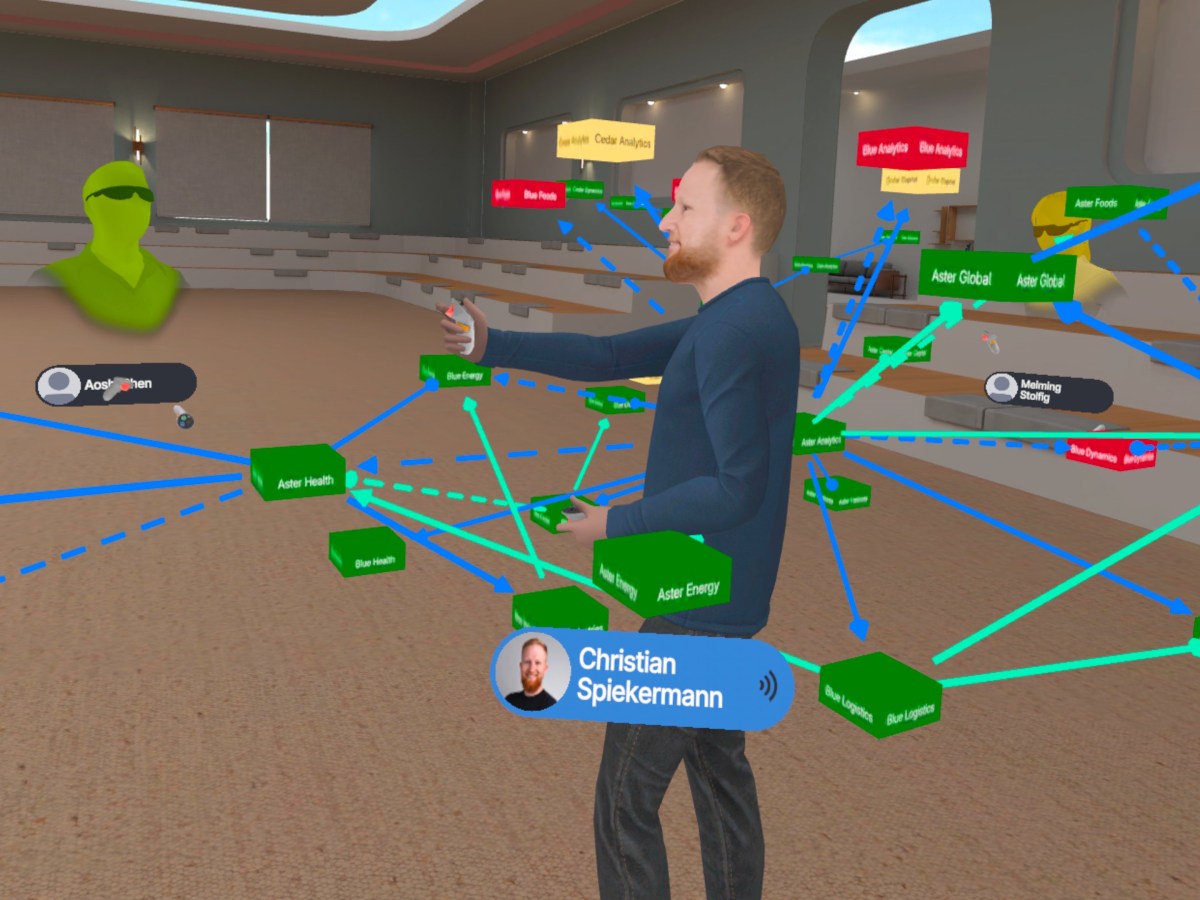
Instead of presenting financial information as isolated tables or sequential charts, multidimensional data can be represented spatially. Relationships, clusters, trajectories, dependencies and anomalies can become visible as structures rather than as individual numbers.
This does not replace quantitative analysis.
It adds another layer between analytical computation and human decision-making. The objective is not to make financial information look spectacular. The objective is to make complex relationships easier to perceive.
From visualization to decision intelligence
This distinction is critical. The future of immersive finance should not be defined by virtual reality as a device category. It should be defined by decision intelligence.
Imagine an institutional investor examining a portfolio in an immersive environment. Risk exposures could be represented spatially. Correlations could become visible as connections between assets. Concentrations could appear as clusters. Scenario simulations could transform the structure of the portfolio in real time. Changes in macroeconomic assumptions could propagate through the investment landscape.
Instead of asking the investor to mentally reconstruct the system from hundreds of individual data points, the interface could provide a perceptual representation of the system itself. That becomes particularly valuable when conventional assumptions are under pressure.
AI may increase the need for human understanding
There is an apparent paradox in Egan-Jones’ argument. If AI reduces the importance of human input in production, one might assume that human decision-makers will become less important everywhere. The opposite may occur in certain domains. As AI generates more analysis, more scenarios and more potential conclusions, humans may face an information interpretation problem rather than an information shortage.
The challenge becomes deciding which signals matter, understanding the relationships between them and determining what assumptions are embedded in the outputs. In other words, AI can automate the production of information without automatically solving the problem of human comprehension. The interface therefore becomes increasingly important.
The next competitive advantage may be the ability to see change
Institutional investors have traditionally competed through information, analytical capabilities, access, expertise and execution. AI may progressively commoditize parts of these advantages. If sophisticated analysis becomes available to almost everyone, the differentiating factor may shift toward the ability to integrate information, recognize structural changes and act upon them. This creates a potentially important role for immersive financial visualization.
A three-dimensional representation of an economic system does not predict the future. But it can provide a different way of seeing the present — and of exploring alternative futures. That distinction matters. Visualization is not forecasting. It is a mechanism for improving the cognitive interface through which forecasting, analysis and decision-making take place.
A new framework for institutional risk management
Egan-Jones describes its analysis as an attempt to provide a framework for sophisticated institutional investors and risk managers as disruption spreads.
Such a framework increasingly needs to address three interconnected dimensions.
| Dimension | Traditional emphasis | Emerging requirement |
|---|---|---|
| Technology | Adoption and investment | Capability acceleration and scalability |
| Economics | Historical trends | Structural change and discontinuities |
| Decision-making | Reports, models and dashboards | Integrated, immersive decision intelligence |
The third dimension deserves particular attention.
Even the best AI models and the most sophisticated financial datasets ultimately have to enter a human decision process — whether through an investment committee, risk function, boardroom or portfolio management system. The quality of that interface can influence how effectively analytical capabilities translate into decisions.
Evidence in an age of synthetic intelligence
There is another issue that becomes increasingly important as AI-generated content proliferates: trust.
If machines can generate financial analysis, scenarios, narratives and visualizations at enormous scale, investors need ways to distinguish between information, inference, assumption and evidence.
Subscribe to get access
Read more of this content when you subscribe today.
An immersive financial environment should therefore not merely display conclusions. It should ideally allow users to investigate the evidence behind those conclusions.
- Where did the data come from?
- Which assumptions were used?
- What changed?
- Which variables are driving the result?
- How sensitive is the outcome?
- What happens under an alternative scenario?
The objective is to transform visualization from a presentation layer into an evidence layer. That could become an important component of institutional decision-making in an AI-driven economy.
The transition from dashboards to economic worlds
The conventional financial dashboard was designed around the assumption that humans could interpret a collection of indicators presented on a screen. But increasingly complex economic systems may require a different paradigm.
- Instead of viewing individual indicators, decision-makers may increasingly interact with representations of entire systems.
- Instead of seeing a risk number, they could explore the structure generating the risk.
- Instead of reading a scenario description, they could experience how the scenario changes the economic landscape.
- Instead of navigating through dozens of charts, they could move through a multidimensional representation of the investment environment.
This is the broader opportunity behind immersive finance.
The real question is not whether AI will replace humans
The debate about AI is often framed around a binary question: Will machines replace human workers?
For investors and risk managers, a more useful question may be:
How will the relationship between machines, humans, information and capital change as AI capabilities continue to accelerate?
If Egan-Jones is correct that AI has crossed a threshold enabling widespread adoption, then this relationship may change faster than traditional financial models assume.
The consequences will not be limited to the technology sector. They may affect virtually every industry in which knowledge, analysis and decision-making contribute to economic value. That makes AI not merely an investment theme, but a potential transformation of the economic environment in which all investments are evaluated.
From information to understanding
The financial industry has spent decades improving its ability to collect, store and process information. AI dramatically accelerates that process. The next challenge is different. It is the ability to understand increasingly complex information quickly enough to make better decisions. This is where Data2Space sees a fundamental opportunity.
Immersive technologies can create a new interface between data, AI-generated analysis and human cognition. By transforming complex financial information into spatial and interactive environments, they can help decision-makers explore relationships that are difficult to perceive in conventional formats.
- The objective is not to replace the analyst.
- It is not to replace the portfolio manager.
- And it is not to replace financial models.
It is to create a more powerful environment in which humans can interrogate data, challenge assumptions, explore scenarios and understand evidence.
If the coming AI transformation fundamentally changes how economic value is created, the financial industry will also need to rethink how economic value is seen.
The future of finance may therefore involve not only artificial intelligence that can analyze the economy, but immersive intelligence that allows humans to experience its structure.
From data to evidence. From evidence to understanding. From understanding to better decisions.

















Leave a comment