

Moody’s Corporation’s decision to acquire a minority stake in Philippine Rating Services Corporation (PhilRatings) is more than a transaction between two credit-rating organizations. It is a strategic signal about the increasing importance, sophistication and international relevance of the Philippine debt capital market.
Moody’s announced on September 14, 2026 that it had agreed to acquire a minority interest in PhilRatings, a leading domestic credit rating agency headquartered in Manila. PhilRatings will continue to operate independently, with its own management, governance and credit-rating processes. The transaction therefore does not represent a takeover of the Philippine rating market. Rather, it creates a closer connection between a deeply rooted domestic rating institution and one of the world’s leading global providers of credit opinions, data and financial analysis.
The timing is significant. The Philippines is entering a phase in which infrastructure investment, corporate financing requirements and the development of domestic capital markets are converging. Moody’s points to more than US$100 billion of planned infrastructure investment in the Philippines over the next three years. At the same time, domestic corporate bonds in ASEAN are more than twice the size of cross-border corporate bond holdings. This underlines why the ability to evaluate domestic credit risk and distribute that information efficiently is becoming increasingly important.
A bond market becoming deeper and more diversified
The Philippine bond market should not be viewed simply as a market for government borrowing. Government securities remain its essential foundation, but the market is gradually becoming a broader financing ecosystem involving banks, corporations, infrastructure projects, retail investors and international investors.
The Bureau of the Treasury continues to conduct regular Treasury-bond and Treasury-bill offerings. Its September 2026 calendar shows continuing weekly activity in both Treasury bonds and bills, demonstrating the regularity and institutional depth of the government securities market.
An important development has been the increasing liquidity of Retail Treasury Bonds (RTBs). According to the Bureau of the Treasury, turnover in RTBs has increased sharply over the past three years. For securities issued in the preceding and current years, the aggregate turnover ratio reached 2.4 in 2025. Non-resident participation also increased from approximately 2% in 2023 to almost 5% in 2025. The Philippine government has consequently been placed on a watch-positive status for potential inclusion in the JPMorgan Government Bond Index–Emerging Markets.
This matters because liquidity is one of the key characteristics separating a developing bond market from a mature one. A bond is not particularly useful to an investor merely because it can be purchased. Investors also need confidence that they can price, monitor and eventually sell the security.
The development of the Philippine market can therefore be understood through several interconnected trends:
| Development | Significance for the Philippine bond market |
|---|---|
| Regular Treasury-bond issuance | Provides a liquid benchmark yield curve |
| Growing RTB trading | Broadens domestic participation and secondary-market liquidity |
| Rising foreign participation | Connects the local market with international capital |
| Corporate bond issuance | Gives companies an alternative to bank financing |
| Infrastructure investment | Creates demand for long-term capital |
| Sustainability bonds | Connects domestic financing with ESG-oriented capital |
| Stronger credit-rating infrastructure | Improves transparency and comparability of credit risk |
| International rating-agency involvement | Strengthens links between domestic and global capital markets |
The expansion is also visible in the sustainability segment. In January 2026, LandBank launched its ASENSO Bonds, peso-denominated fixed-rate sustainability bonds designed to finance projects including renewable energy, sustainable water management and urban development. The minimum investment of PHP 10,000 was intended to broaden participation in the capital market.
Monetary policy is changing the environment for bonds
The Philippine bond market is developing against a monetary-policy background that has become considerably different from the very high-rate environment of the previous cycle.
As of September 4, 2026, the Bangko Sentral ng Pilipinas (BSP) maintained its target reverse repurchase rate at 5.00%, with the overnight lending facility at 5.50% and the overnight deposit facility at 4.50%.
Subscribe to get access
Read more of this content when you subscribe today.
For bond investors, this illustrates an important point: the direction of interest rates cannot be analyzed independently from inflation, currency movements, global energy prices and international monetary policy.
That is particularly relevant in September 2026. Global bond markets have recently faced renewed pressure from higher oil prices, inflation concerns and uncertainty about the future path of U.S. monetary policy. U.S. Treasury yields have approached the 5% level, while investors have become increasingly concerned about fiscal deficits and the supply of government and corporate debt.
The Philippine market is consequently exposed to two opposing forces. Lower domestic rates can support bond valuations and reduce financing costs, while higher global yields can put upward pressure on Philippine yields and make dollar-denominated investments relatively more attractive.
Credit ratings become more important as the market expands
This is precisely where the Moody’s investment in PhilRatings becomes strategically relevant.
In a small and relatively concentrated debt market, investors can sometimes rely heavily on established relationships and direct knowledge of issuers. As the market grows, that approach becomes less sufficient. More issuers, more instruments and more investors create a greater need for standardized information.
Credit ratings perform an important function in this process. They do not eliminate credit risk, nor do they constitute investment recommendations. Their role is to provide an analytical framework through which investors can compare the relative creditworthiness of different issuers and securities.
For Philippine companies seeking capital, this can become particularly important as they move beyond traditional bank financing. A company issuing bonds needs to communicate its credit profile to investors who may not have detailed knowledge of its business, ownership structure, subsidiaries, cash flows or competitive environment.
The relationship between credit ratings and capital-market development is therefore circular:
More issuers → more information requirements → greater need for credible credit analysis → broader investor participation → greater financing opportunities → deeper capital markets.
Moody’s describes PhilRatings’ local expertise as complementary to its global credit perspective. This is potentially important because credit risk is simultaneously local and international. A Philippine company’s ability to service debt may depend on domestic regulation, local competition, peso liquidity and Philippine economic conditions, while investors may simultaneously compare its bonds with opportunities across Asia and other emerging markets.
Infrastructure could become a major driver
The Philippine government’s infrastructure ambitions make the development of long-term debt financing particularly relevant.
Infrastructure projects require capital with maturities that are often considerably longer than conventional bank loans. Roads, railways, airports, energy facilities, water systems and digital infrastructure generate economic returns over many years. A deeper domestic bond market can provide a mechanism for transforming long-term savings into long-term investment.
This also explains why Moody’s explicitly connects the development of the debt market with the more than US$100 billion of planned infrastructure investment mentioned in its announcement.
The challenge is not simply to raise money. Capital must be allocated efficiently. Investors need to understand who owns a project, who ultimately guarantees its obligations, which subsidiaries generate cash flow, where liabilities sit within a corporate group and what happens under different economic scenarios.
That makes the information architecture surrounding credit increasingly important.
From isolated ratings to connected financial information
The next stage of development may therefore involve moving beyond the traditional presentation of credit information.
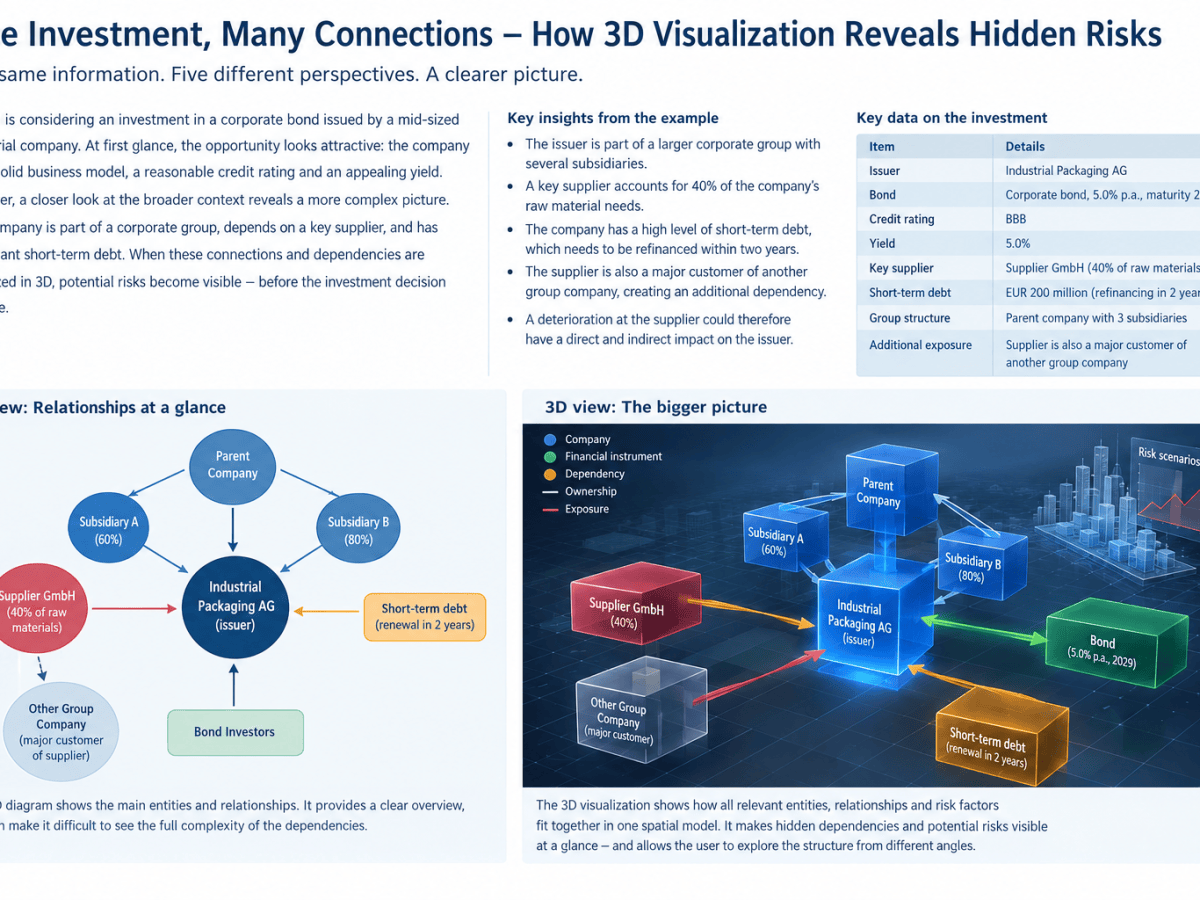
A credit rating is normally communicated through a rating symbol, a research report, financial statements and a series of analytical assumptions. Yet modern corporate structures can be extraordinarily complex. A single issuer may be connected to holding companies, subsidiaries, joint ventures, minority interests, guarantees, lenders, bondholders and other financial instruments.
Understanding the credit risk of such an organization requires more than reading individual pieces of information. The relationships between those pieces matter.
This is where spatial visualization can add another analytical dimension. Instead of examining a corporate group exclusively through tables, documents and screens, ownership structures, financial relationships and credit-relevant dependencies can be represented as interconnected three-dimensional structures.
For investors, analysts and rating professionals, such an approach can help make questions visible that are difficult to perceive in conventional documents:
- Who ultimately controls the issuer?
- Which subsidiaries generate the relevant cash flows?
- Where are the group’s major liabilities located?
- Which companies provide guarantees or other forms of support?
- How are debt instruments connected to the broader corporate structure?
- What changes when ownership, financing or cash-flow assumptions change?
The value is not that visualization replaces financial analysis. Rather, it can provide another way of navigating the relationships on which that analysis depends.
The Philippine market is becoming more interesting for international investors
The combination of a growing domestic investor base, rising foreign participation, infrastructure requirements and improving market infrastructure makes the Philippines an increasingly relevant bond market within Asia.
The country’s external debt stood at approximately US$154.9 billion in the second quarter of 2026, according to BSP statistics, while the Philippine peso was trading around PHP62.54 per U.S. dollar on September 11.
Currency risk therefore remains an important consideration for international investors. A foreign investor buying peso-denominated bonds is not only assessing the issuer and interest rate. The investor is also taking a view on the peso and on the interaction between Philippine monetary policy and global financial conditions.
At the same time, the Philippine government continues to access international capital markets. In January 2026, the Republic launched a three-tranche U.S.-dollar global bond offering with 5.5-year, 10-year and 25-year maturities.
The coexistence of domestic-peso and international-dollar financing is important. It gives the Philippines multiple channels through which government and corporate borrowers can access capital, but it also makes the analytical framework more complex.
Why the Moody’s–PhilRatings transaction matters
The acquisition of a minority stake in PhilRatings can therefore be interpreted as part of a much broader transformation.
It brings global rating expertise closer to a domestic market that is becoming more important. It reinforces the role of independent credit research. It potentially strengthens analytical standards and technical capabilities. And it comes at a time when the Philippine economy requires substantial amounts of long-term capital to finance infrastructure and corporate expansion.
Perhaps most importantly, the transaction recognizes that a functioning bond market depends on more than buyers and sellers.
It depends on information.
Investors need reliable information about issuers. Issuers need credible mechanisms for communicating their credit quality. Rating agencies need high-quality financial and corporate data. Regulators need transparency. And increasingly, investors need tools that allow them to understand complex relationships rather than simply read isolated numbers.
The Philippine bond market is consequently moving from a relatively traditional model of debt issuance toward a more interconnected capital-market ecosystem. Moody’s investment in PhilRatings is a visible manifestation of that transition.
For the Philippines, the long-term opportunity is substantial. If infrastructure investment, corporate financing, domestic savings, foreign capital, credit analysis and market technology develop together, the domestic bond market can become more than a funding mechanism for the government. It can become one of the country’s principal engines for converting savings into productive investment.



















Leave a Reply