
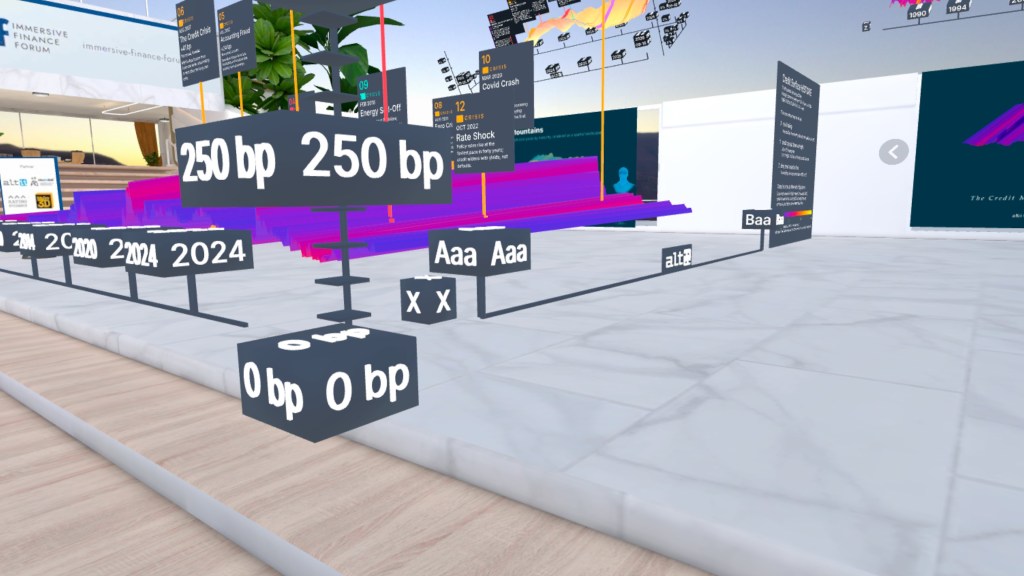
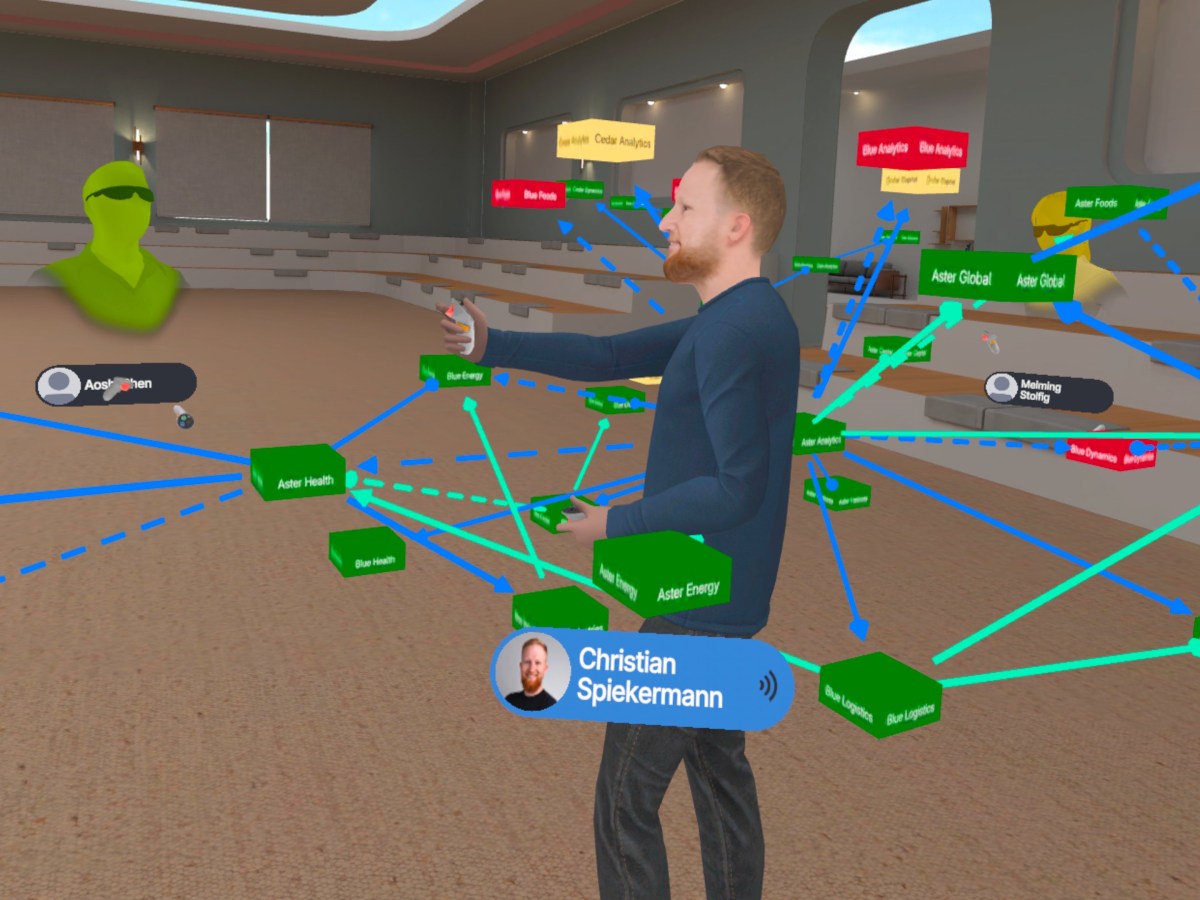
How can credit ratings become easier to understand, explain and challenge? The Immersive Finance Forum on 13 October 2026 demonstrated how spatial computing can transform complex financial data into interactive three-dimensional environments. Under the title “Walking Through Markets, Telling Fund Stories,” participants explored new ways to visualize market risks, credit spreads and investment histories in a shared virtual space using Arthur.
One of the most relevant applications for credit rating is the Credit Mountain, which translates credit spreads across rating categories into a spatial landscape. Differences between credit quality levels become visible through changes in the terrain, while colours represent the dispersion between the highest and lowest spreads. This creates an intuitive way to explore how markets differentiate between credit risks and how these differences can change during periods of financial stress.
For credit analysts, rating agencies and investors, the potential extends beyond visualization. A credit rating is more than a letter or a score: it represents an assessment of an issuer’s ability to meet its financial obligations. Understanding that assessment requires consideration of multiple factors, their interdependencies and the assumptions underlying the analysis. Immersive environments can help make these relationships more accessible, supporting the discussion and critical examination of analytical conclusions.
The forum also presented the Interest Rate Mountain, the Volatility Mountain and the Expectations Landscape. Together, these models illustrate how interest rate developments, options market data and market-implied expectations can be explored spatially. Such perspectives can enrich credit analysis by providing a broader view of the financial environment in which borrowers and issuers operate.
A second highlight was the Fund Helix, a walkable spiral that connects a fund’s history with major market events. By placing internal milestones alongside external developments, it demonstrates how immersive environments can contextualize financial performance and support more meaningful discussions with investors.
The Helicoid, an exhibition of seventeen different virtual presentation architectures, addressed another important question: how should information be arranged to make its meaning clear? A timeline, a spiral or a spatial overview each emphasizes different relationships. For credit rating communication, selecting the right structure could help explain rating changes, risk factors and the evolution of an issuer’s creditworthiness.
The central message is that immersive technology does not replace credit analysis or professional judgment. It can make complex analytical relationships more transparent and accessible, helping human decision-makers examine the evidence behind a rating rather than relying solely on a final score.
For rating agencies, credit analysts, asset managers and investors, spatial computing therefore offers a promising additional instrument for financial communication. The Immersive Finance Forum demonstrated how the next generation of credit risk communication could move beyond tables and charts towards interactive environments in which financial relationships can be explored together.
Further information about upcoming events is available at immersive-finance-forum.de.a


















Leave a Reply