

Credit ratings are often associated with financial ratios: leverage, liquidity, profitability, cash flow and debt-service capacity. Yet the resilience of a company cannot be understood from financial figures alone. Behind every balance sheet stands an operating organization—and operational weaknesses can become financial weaknesses when disruptions affect revenues, costs, liquidity, reputation or the ability to service debt.
This makes operational risk an important bridge between the operational reality of a company and its credit profile.
Major rating methodologies already reflect this broader perspective. S&P Global Ratings, for example, describes credit ratings as forward-looking opinions based on both quantitative and qualitative factors, including business sustainability, management quality and risk management. Fitch’s current corporate criteria likewise consider business, financial and operational characteristics, with rating committees using historical and forecast information to arrive at a rating outcome.
The challenge for companies, therefore, is not simply to demonstrate that their financial numbers are sound. They must increasingly be able to demonstrate that the operating system behind those numbers is resilient.
Operational risk is a credit risk
Operational risk is sometimes treated as a separate discipline: an issue for compliance, internal audit, IT security or enterprise risk management. From a credit-rating perspective, however, its significance is much broader.
Consider a company with apparently strong financial metrics. It may have moderate leverage, adequate liquidity and stable margins. But what happens if a critical IT system fails? What if a key supplier becomes unavailable? What if a cyberattack interrupts operations? What if the organization depends on a small number of individuals with highly specialized knowledge? What if management is unable to coordinate effectively during a crisis?
These events can rapidly translate operational disruption into financial consequences.
Fitch’s corporate criteria explicitly identify operational characteristics alongside financial and business factors and note the importance, depending on the sector, of areas such as risk management, resource management, revenue visibility and operational flexibility. (Fitch Ratings)
S&P Global Ratings similarly emphasizes that management’s strategic competence, operational effectiveness and ability to manage important strategic and operating risks can influence an enterprise’s credit profile. (S&P Global)
The central question is therefore not simply:
“Does the company have sufficient financial resources?”
It is also:
“Can the company continue to generate and protect those resources when its operating environment becomes stressed?”
That is the point at which operational risk becomes credit risk.
The hidden structure behind a rating
A corporate credit rating can be viewed as the result of multiple interconnected layers.
At the financial level are metrics such as leverage, liquidity, profitability and cash-flow generation. At the business level are industry characteristics, competitive position, market dynamics and geographical exposure. At the organizational level are management quality, governance, risk management, operational capabilities and resilience.
These layers interact.
A cyber incident, for example, is initially an operational event. But if it stops production or customer services, it becomes a business event. If the interruption causes revenue losses and additional costs, it becomes a financial event. If liquidity deteriorates and debt-service capacity is impaired, it becomes a credit event.
Operational risk therefore travels through the organization.
The difficulty is that this transmission mechanism is not always visible in conventional financial reporting.
A spreadsheet can show the resulting decline in EBITDA. It is much less effective at showing the network of dependencies that caused the decline.
From risk register to risk architecture
Traditional risk management often represents operational risks in registers: risk category, probability, potential impact, responsible department and mitigation measure.
These tools are valuable, but they can also fragment the picture.
A rating analyst, CFO, CRO or investor may need to understand something more fundamental:
Which operational dependencies could ultimately affect the company’s capacity to service its obligations?
That requires connecting different information domains.
Imagine, for example, a manufacturing company with:
- three critical production sites;
- two strategic suppliers;
- a shared IT infrastructure;
- a centralized logistics function;
- several subsidiaries;
- significant exposure to one geographical market;
- a concentrated customer base; and
- debt covenants linked to cash-flow performance.
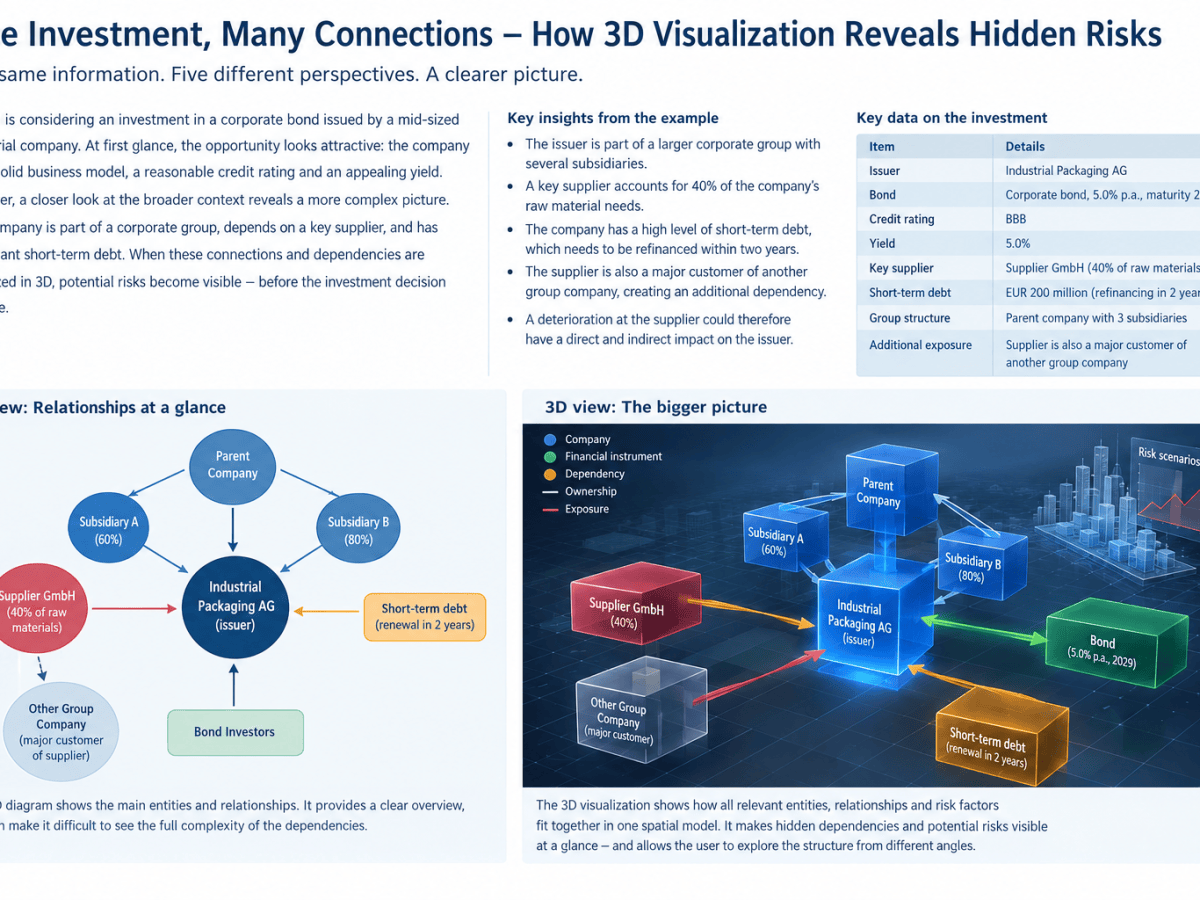
Each element may be monitored separately. But the credit risk emerges from the relationships between them.
If a single IT platform supports several production sites, the operational concentration may be much greater than it first appears. If one supplier provides a critical component to multiple subsidiaries, supplier dependency may be hidden within the group structure. If those subsidiaries simultaneously experience disruption, liquidity and covenant headroom may be affected.
The operational risk is therefore not located in one box.
It exists in the network.
Why 3D visualization matters for credit analysis
This is where the approach of Data2Space becomes particularly interesting.
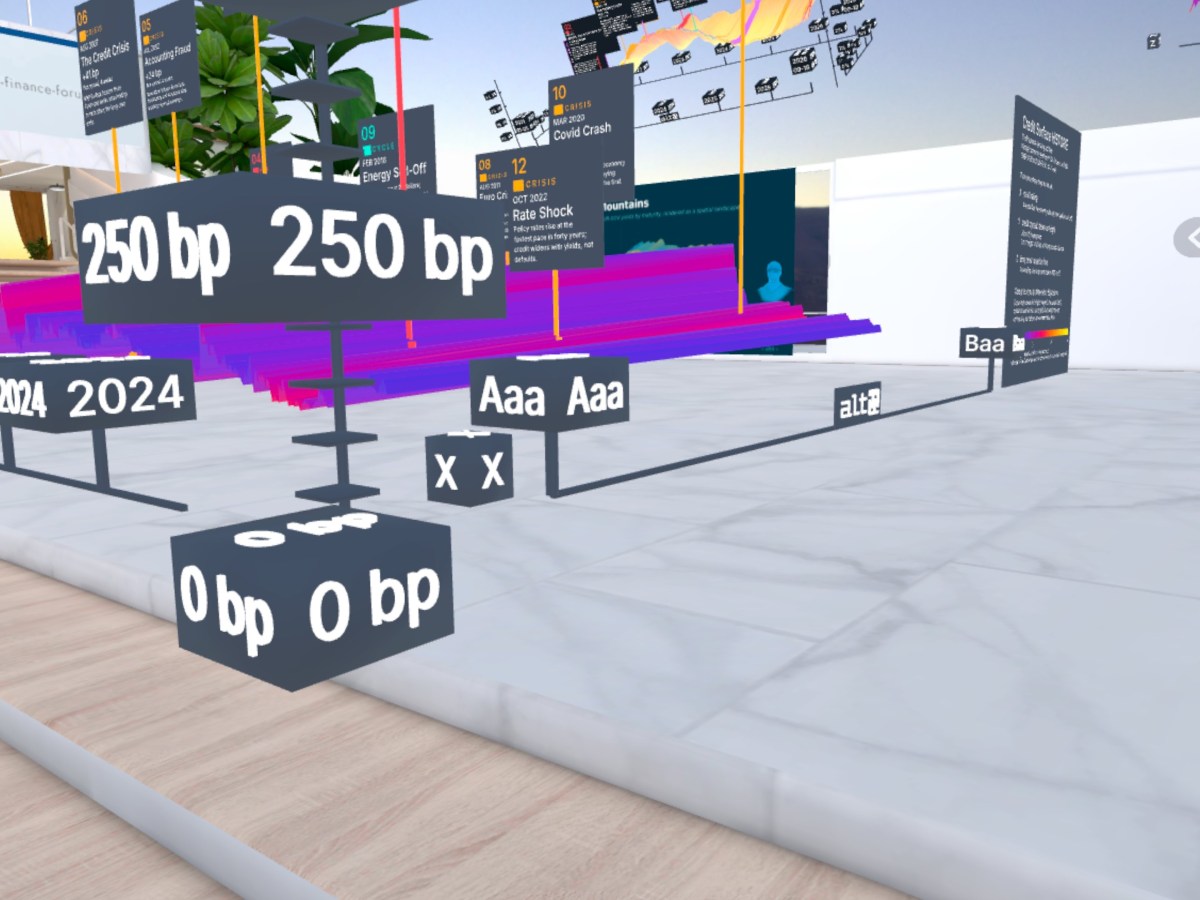
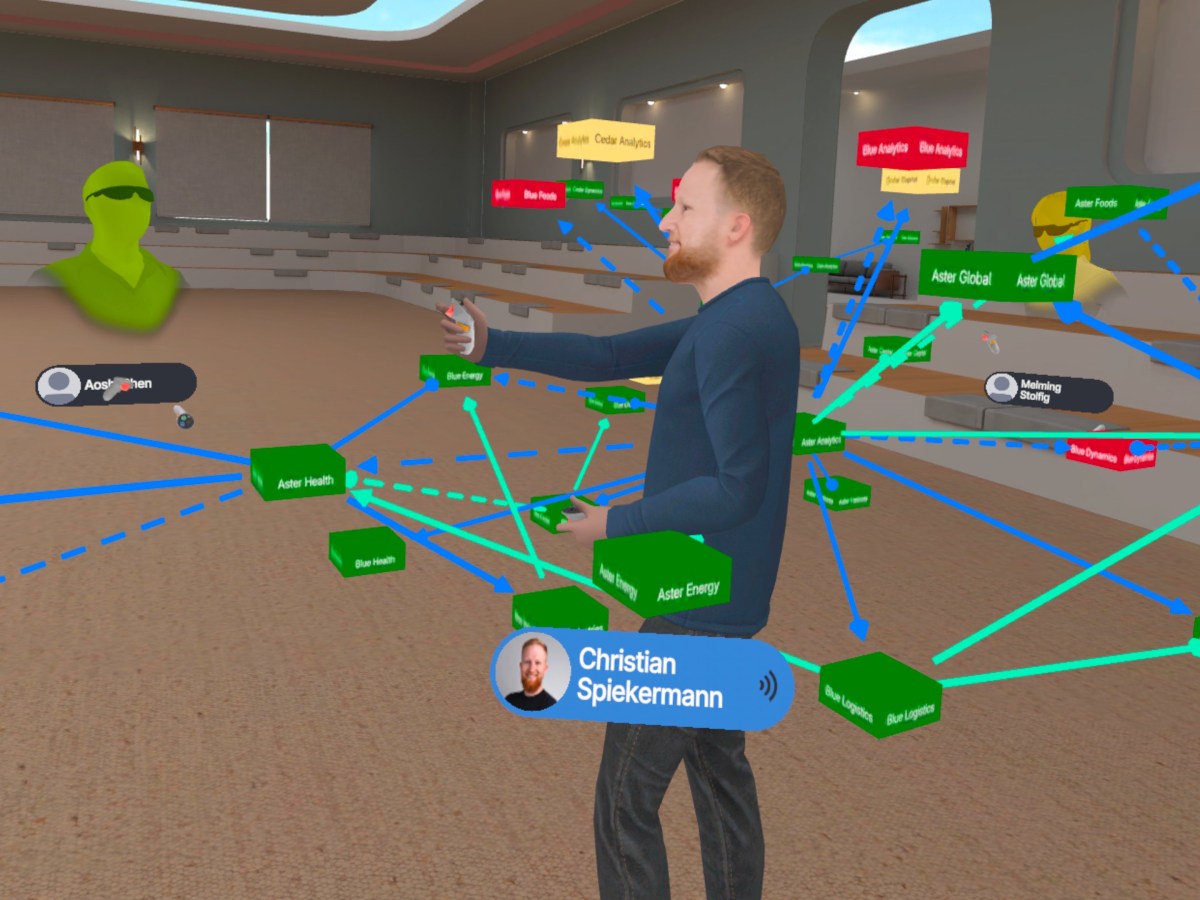
The company’s concept of turning data into interactive spatial environments offers a different way of looking at complex corporate information. Instead of treating data points as isolated objects, relationships can become part of the visual environment itself.
For credit analysis, this creates an opportunity to move from a collection of risk indicators toward a spatial representation of the company’s risk architecture.
A three-dimensional model could, for example, connect:
Company → Business Units → Locations → Suppliers → IT Systems → Processes → Revenues → Cash Flows → Debt Obligations → Rating Factors
The objective would not be to replace established rating methodologies. Rather, spatial visualization could provide an additional analytical layer that helps decision-makers understand how the factors interact.
This distinction is important because rating methodologies are deliberately structured analytical frameworks. Moody’s, for example, describes its methodologies as frameworks that guide rating committees in considering quantitative and qualitative factors, while emphasizing that committees apply analytical judgment when determining how factors should be weighted.
A spatial model can support that judgment by making relationships more transparent.
From an operational incident to a rating impact
Consider a hypothetical scenario.
A company depends on a cloud-based technology platform for customer orders, production planning and invoicing. The platform becomes unavailable for several days.
In a conventional risk register, the event might be classified as:
IT Risk → System Outage → Medium/High Impact
Subscribe to get access
Read more of this content when you subscribe today.
The operational event has now become a chain of potential credit consequences.
A spatial visualization could represent this chain as a connected pathway through the organization. Analysts could start with the operational risk and follow its potential consequences through business processes, financial metrics and ultimately credit-relevant factors.
The important insight is that risk propagation becomes visible.
Operational resilience and management quality
This also connects strongly with the work of Tanja Gatzke on resilience and soft skills.
Her contribution to Soft Skill Rating, published by Springer Gabler in the book by Dr. Oliver Everling and Dominik Wever, argues that resilience should be understood not merely as an individual characteristic but as an organizational resource. In high-pressure situations, the ability to regulate stress, communicate clearly, make decisions and maintain cooperation affects the functioning of teams and organizations.
This has direct implications for operational risk.
Two companies can have identical technology, similar financial resources and comparable business models. Yet their ability to respond to a crisis may be fundamentally different.
One organization may have:
- clear crisis responsibilities;
- experienced leadership;
- effective escalation procedures;
- strong communication;
- tested business-continuity processes;
- redundant resources; and
- employees capable of making decisions under pressure.
Another may have the same formal procedures but lack the organizational capability to execute them effectively.
For a credit analyst, this distinction matters because operational resilience determines whether a theoretical risk actually becomes a material financial disruption.
Gatzke’s analysis emphasizes that resilience supports the ability to apply soft skills under pressure and that these capabilities contribute to maintaining decision quality and organizational functionality.
This suggests an important extension of operational-risk analysis:
Do not only ask whether a control exists. Ask whether the organization can actually perform the control under stress.
The human factor in operational credit risk
Operational risk is often associated with systems, processes and technology. But organizations ultimately depend on people.
Under high pressure, decision-making can deteriorate. Gatzke’s article describes how stress can narrow perception and make it more difficult to process complex information and maintain effective communication.
For credit analysis, this creates another dimension.
A company may have excellent business-continuity documentation, but if its management structure becomes dysfunctional during a crisis, the practical resilience of the organization may be significantly lower than its formal risk documentation suggests.
This is why management and governance are increasingly important components of corporate credit analysis. S&P Global Ratings’ current management and governance framework explicitly treats these factors as relevant to creditworthiness and evaluates multiple subfactors before arriving at a final modifier.
Operational risk is therefore partly about organizational behavior.
It is about whether the company can transform plans into action.
Making rating drivers explorable
The next generation of credit analytics could benefit from making these relationships interactive.
Imagine a rating environment in which an analyst can enter a company’s organizational structure and immediately see the connections between:
Operational Dependencies
→ critical suppliers
→ IT infrastructure
→ production assets
→ key personnel
→ logistics
→ geographic concentration
Business Risk
→ market position
→ industry exposure
→ customer concentration
→ competitive environment
Financial Risk
→ EBITDA
→ leverage
→ liquidity
→ free cash flow
→ refinancing requirements
Credit Resilience
→ contingency capacity
→ management response
→ operational redundancy
→ risk governance
→ recovery capability
Rather than presenting these categories as separate pages, a spatial information environment could allow the analyst to navigate between them.
A weak operational dependency could be followed into its financial consequences. A financial vulnerability could be traced back to the operational assumptions underlying it. A management weakness could be connected to specific crisis scenarios.
The result is not simply a visualization of the rating.
It is a visualization of the causal architecture behind the rating.
A new perspective on rating transparency
Credit ratings necessarily involve analytical judgment. No visualization can eliminate uncertainty or replace the rating committee.
But better visualization can improve the transparency of the information underlying that judgment.
This is especially relevant because rating methodologies themselves emphasize that individual factors do not necessarily carry identical weight. Fitch, for example, states that where one factor is significantly weaker than others, that weakest element can attract greater weight in the analysis.
This principle can be represented spatially.
A company may look strong across most dimensions while having one critical operational vulnerability. Instead of allowing that vulnerability to disappear within a long list of indicators, an interactive risk model could make it visually prominent and show the network of dependencies attached to it.
The question becomes:
Where is the weakest link—and how far can its consequences travel?
That is a highly relevant question for credit analysis.
Operational Risk as a bridge between ESG, resilience and credit
The broader development is that credit analysis is increasingly concerned with factors that sit outside traditional accounting statements.
Operational resilience, governance, cyber risk, supply-chain dependency, climate exposure, management quality and organizational capabilities can all influence a company’s ability to generate stable cash flows and meet financial obligations.
They should not automatically be treated as separate rating categories. Their relevance depends on how they interact with the company’s specific business model and financial structure.
This is precisely why a network-oriented approach can be valuable.
Instead of asking whether a company has “high cyber risk” or “high supply-chain risk,” analysts can ask:
How does this risk connect to the company’s cash flow, liquidity, asset base and debt obligations?
That is a much more credit-oriented question.
The future: Credit Rating Intelligence
The combination of structured rating methodologies, operational-risk analysis and 3D data visualization points toward a broader concept: Credit Rating Intelligence.
Its purpose would not be to automate the rating decision. Rather, it would help analysts understand the complex system from which credit risk emerges.
The system could combine financial data, operational data, organizational structures, risk information and scenario analysis in a common spatial environment.
A credit analyst could then move from:
“The company has a BBB rating.”
to:
“Here is why the company has this rating, which operational dependencies support it, where its vulnerabilities are located, and how a disruption could propagate through the business and ultimately affect its financial resilience.”
That is a fundamentally different form of transparency.
It moves the conversation from rating the company toward understanding the company behind the rating.
And in an economy characterized by cyber threats, supply-chain disruptions, geopolitical uncertainty and increasingly complex organizational structures, that distinction may become increasingly important.
Operational risk is no longer merely something that sits beside credit risk.
It is one of the pathways through which credit risk is created.
The analytical challenge for the next generation of ratings is therefore to make those pathways visible—and to give decision-makers the tools to explore them.
A practical opportunity to explore these questions further will be provided by Tanja Gatzke at the BVMW event “KRITIS-Check-up: Das Präventionsfrühstück” on 3 November 2026 in Wiesbaden. From 9:00 a.m. to 1:00 p.m., decision-makers and executives from critical infrastructure sectors—including finance—will discuss current challenges at the intersection of physical security, cyber resilience and crisis management. With contributions from POLIZEI DEIN PARTNER, Securitas, CANCOM and the Hessian State Criminal Police Office, the event focuses on how organizations can identify threats at an early stage, maintain operational capability during crises and strengthen resilience. The event thus provides a valuable practical setting for the broader question of how operational resilience can become a more visible and assessable component of corporate risk—and, ultimately, of creditworthiness.
















Leave a Reply