

The presentation has been one of the most enduring formats of business communication. For decades, financial professionals have relied on PowerPoint slides to explain investment strategies, financial products, company structures, market developments and strategic decisions. The format is familiar and efficient—but it is also fundamentally linear.
Data2Space introduces a different concept: instead of presenting information slide by slide, why not allow the audience to enter an interactive information environment?
Data2Space transforms presentations into spatial, interactive and collaborative experiences. The result is not simply a presentation with more sophisticated graphics. It is a different presentation paradigm in which the audience can explore the information itself.
From Slide Decks to Information Spaces
A conventional presentation follows a predetermined sequence. Slide 1 introduces the topic, slide 2 provides background, subsequent slides explain details, and the final slides summarize the conclusions.
This structure works well when the message is linear. Financial subjects, however, are often not linear.
An investment portfolio consists of multiple assets and relationships. A company consists of business units, subsidiaries, markets and financial structures. A financial product may combine physical assets, financing, cash flows, risks and scenarios.
Trying to explain such structures through a succession of slides inevitably means breaking the relationships between the individual elements apart.
Data2Space takes the opposite approach. Information can remain connected within a three-dimensional environment. The presenter can move between topics while maintaining the context of the overall structure.
The Presenter Becomes a Guide
This changes the role of the presenter.
In a traditional presentation, the presenter controls the sequence of information. The audience follows the presenter through the slide deck.
In an immersive presentation, the presenter can become a guide through an information space.
A question from the audience does not necessarily require abandoning the presentation sequence. The presenter can move directly to the relevant part of the environment, examine a particular relationship or zoom into a specific detail.
The presentation therefore becomes more responsive to the audience.
Instead of saying, “We will come to that on slide 27,” the presenter can potentially move directly to the relevant information.
The Audience Becomes a Participant
The most significant change may concern the audience itself.
Traditional presentations are largely observational. Participants look at the screen while the presenter speaks.
Data2Space creates the possibility of participation. Users can explore information, interact with visualizations, examine details and investigate relationships themselves.
This is particularly valuable when presenting complex financial information. Different participants may have different questions and areas of interest. One person may want to understand the portfolio structure, another the risk profile, and another the relationship between individual investments.
An interactive environment can accommodate these different perspectives without requiring a separate presentation for each participant.
Charts Become Spatial Objects
The transformation is not limited to making presentations three-dimensional.
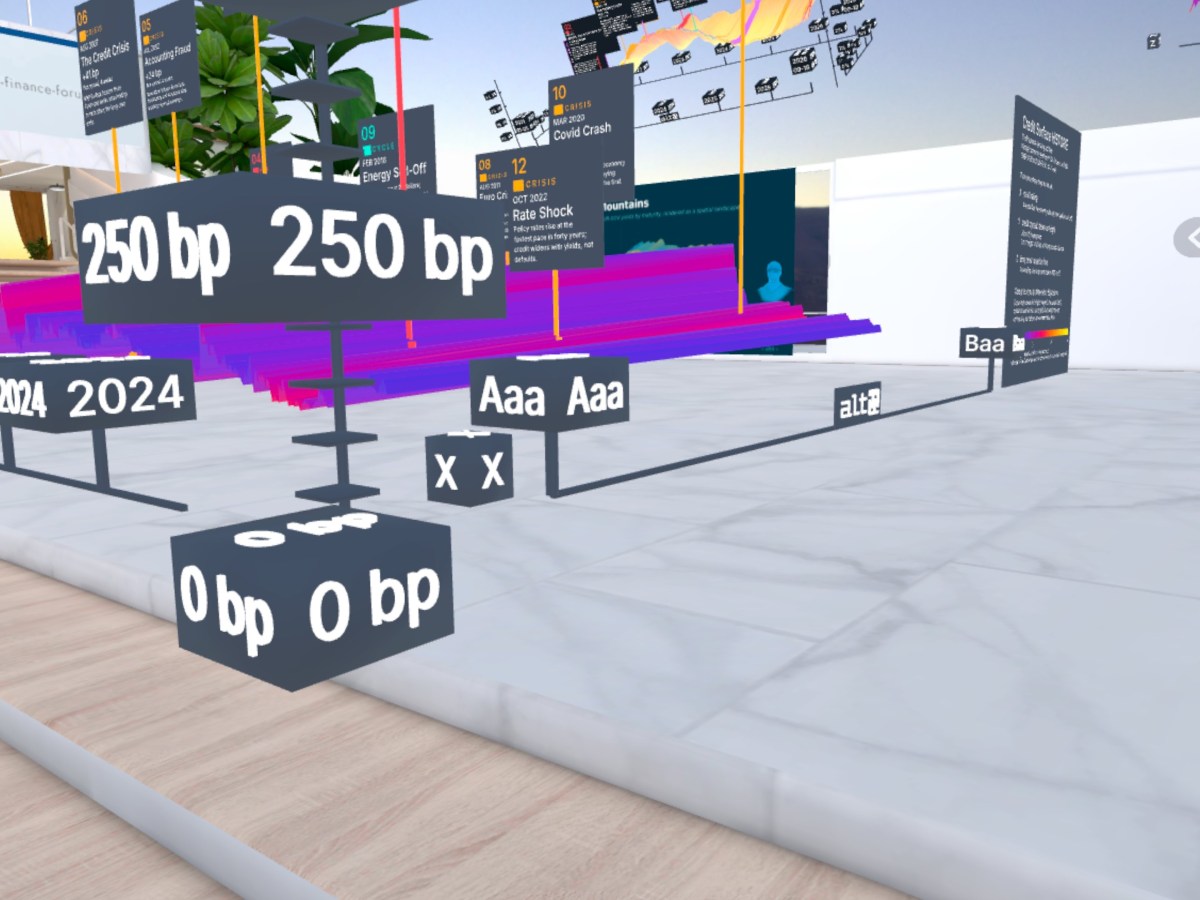
Charts, financial data, models, visualizations and other presentation elements can become objects within a spatial environment.
This changes their role. A chart is no longer necessarily something that appears for a few seconds and then disappears when the next slide is shown. It can become part of a larger information landscape.
The presenter can approach it, provide context, compare it with other information and move between different levels of detail.
The spatial arrangement itself can communicate relationships.
Context Becomes Part of the Message
One limitation of slide-based communication is that context is easily lost.
A chart may show an investment return, but the underlying asset, geographic location, ownership structure or related risks may be presented on completely different slides.
A spatial environment allows these elements to coexist.
A portfolio could be represented as a landscape of investments. A company could be represented through its corporate structure. A real-estate investment could combine the physical property, its location, financial data and development scenarios.
The presentation can therefore preserve relationships that are difficult to maintain in a linear slide deck.
Presentations Can Become Non-Linear
The ability to move freely through an information space introduces another important characteristic: non-linearity.
A presenter can start with the overall picture, move into a particular area, respond to a question, investigate another relationship and return to the overview.
The presentation becomes dynamic rather than predetermined.
This does not mean that storytelling disappears. On the contrary, storytelling can become more flexible. The presenter still establishes the narrative, but the narrative can adapt to the audience.
From Screen to Shared Space
Data2Space also changes the physical setting of a presentation.
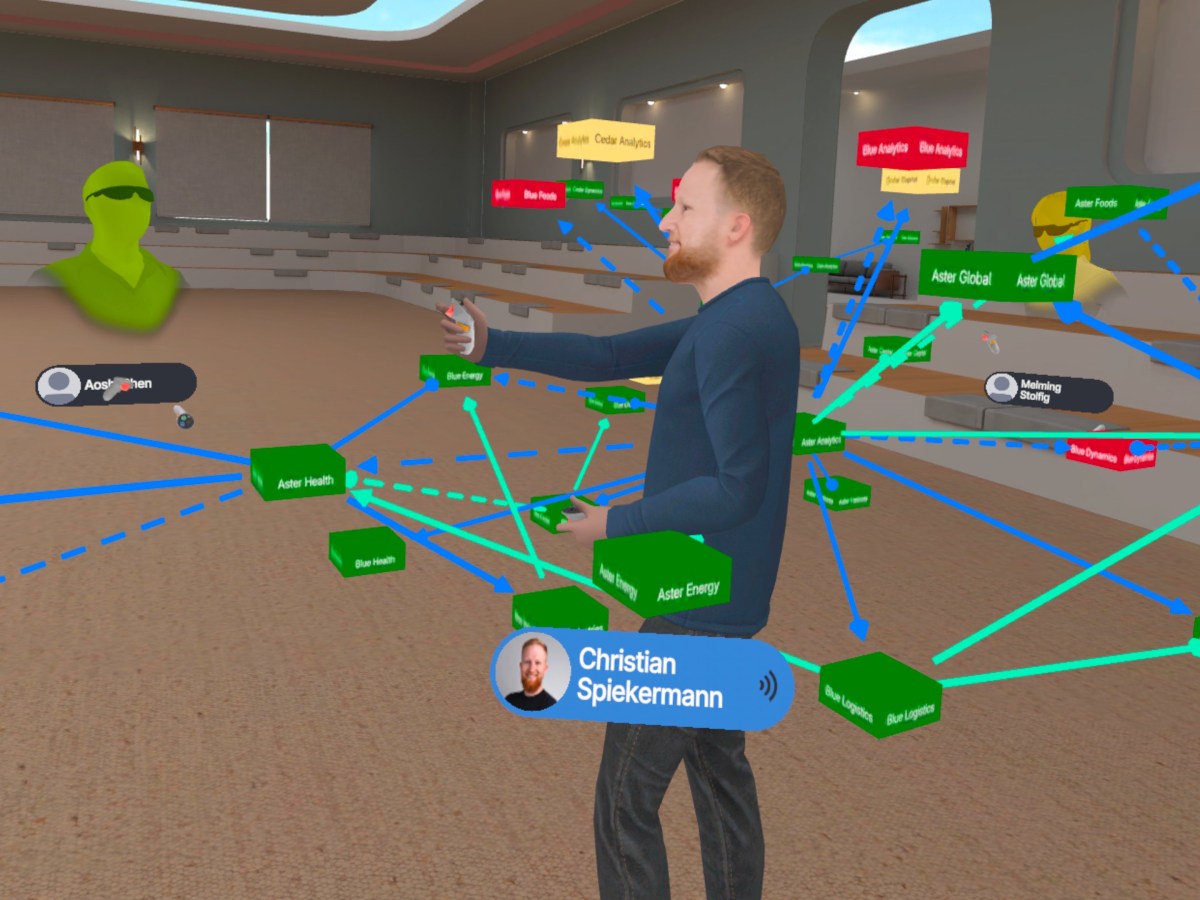
Immersive experiences can be brought into meeting rooms and experienced collaboratively. With XR devices, participants can enter the same spatial environment and interact with the information from different perspectives.
The concept is therefore not restricted to an individual virtual-reality experience.
It can become a shared information space in which participants discuss what they see and investigate the same underlying model.
This is particularly relevant for client meetings, investment committees, workshops and strategic discussions.
A New Format for Investment Presentations
Financial services are an obvious application area.
Investment strategies, portfolios, market developments, corporate structures and financial products often contain relationships that are difficult to communicate through static slides.
An immersive presentation can preserve these relationships.
An investment portfolio, for example, could be visualized as an interactive environment in which participants explore individual investments, sectors, geographical exposure or other analytical dimensions.
A corporate presentation could allow users to move through subsidiaries, ownership relationships and business activities.
A financial product could be presented as an interactive environment combining its assets, financial characteristics and scenarios.
The presentation becomes an analytical model rather than merely an explanation of an analytical model.
Collaboration Changes the Meeting
Another important characteristic is collaboration.
When participants share the same spatial environment, the presentation can become a working session.
People can discuss individual elements, investigate relationships and develop a common understanding of the subject.
This is fundamentally different from sending a presentation file to participants or sharing a screen during a video conference.
The objective is not simply that everyone sees the same content. The objective is that everyone can interact with the same information environment.
From Presentation to Decision-Making Environment
This opens an even broader possibility.
A presentation does not necessarily have to end when the presenter reaches the final slide.
If the underlying environment remains interactive, participants can continue exploring the information after the formal presentation. Questions can lead directly to further analysis. Alternative scenarios can be examined. Specific relationships can be investigated.
The presentation therefore begins to merge with decision support.
For investment committees, management meetings or strategic workshops, this could be particularly valuable. The same environment that explains a decision can also provide the information needed to discuss and evaluate it.
The End of the Slide Deck?
Data2Space does not necessarily mean that PowerPoint and traditional presentations will disappear.
Slides remain highly effective for many forms of communication. The important development is that they no longer have to be the only interface between financial information and an audience.
For complex subjects, the spatial presentation offers an additional medium.
The difference can be summarized simply: a traditional presentation shows information to an audience. An immersive presentation gives the audience a space in which information can be explored.
That is the fundamental innovation behind Data2Space’s Immersive Presentations.
The presentation becomes interactive. The audience becomes participatory. Charts become spatial objects. Context remains connected. The narrative can adapt to questions. And the meeting itself can become a shared analytical environment.
In this sense, Data2Space is not merely creating a new type of presentation. It is exploring what comes after the slide deck: presentations that audiences do not simply watch, but enter, navigate, investigate and discuss.
















Leave a Reply