
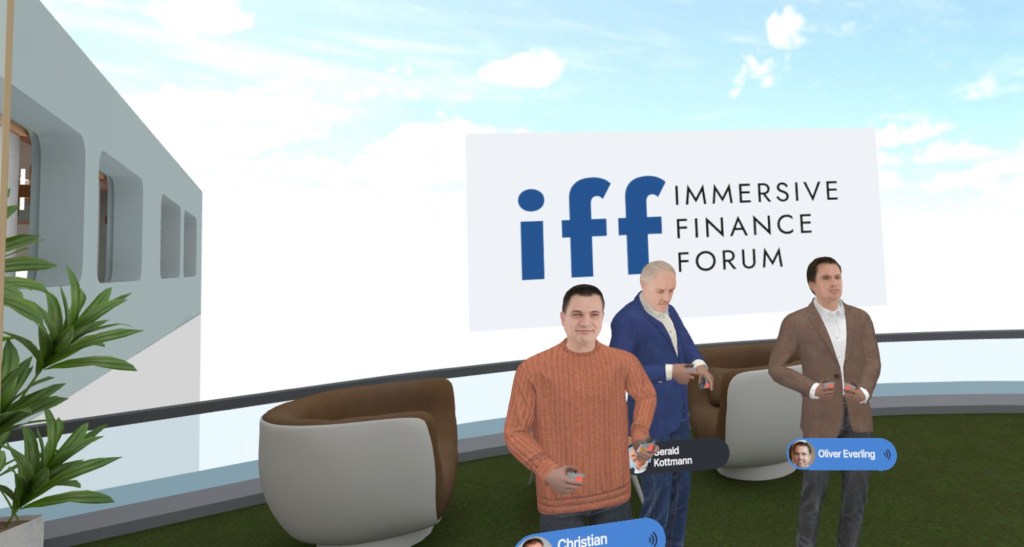
“Return on Investment You Can Touch: The Premiere of the Immersive Finance Forum in VR” — this headline from altii GmbH captures the central idea behind the Immersive Finance Forum (IFF), which held its premiere on August 11, 2026. Instead of a conventional conference room or a webinar window, participants met inside a shared virtual environment on the Arthur VR platform, using Meta Quest 3 headsets. Financial communication became a place that participants could enter, explore and experience together.
The IFF is modeled on the European Finance Forum (EFF) and is organized by Christian Salow of altii in cooperation with Dr. Oliver Everling of RATING EVIDENCE. The concept combines the established principles of a professional finance forum — expert presentations, discussion and networking — with the possibilities of immersive technology. The objective is not simply to reproduce a conventional conference in virtual reality, but to explore what becomes possible when financial information and communication are transformed into a three-dimensional environment.
The premiere was deliberately organized as a small, carefully selected group. This allowed participants to familiarize themselves with the virtual environment, experiment with its functions and contribute to shaping the format. According to the altii report, this intimacy was one of the strengths of the evening: “Whoever normally sits next to others in rows of chairs here stood together in front of the same objects, walked around them and discussed them at eye level.”
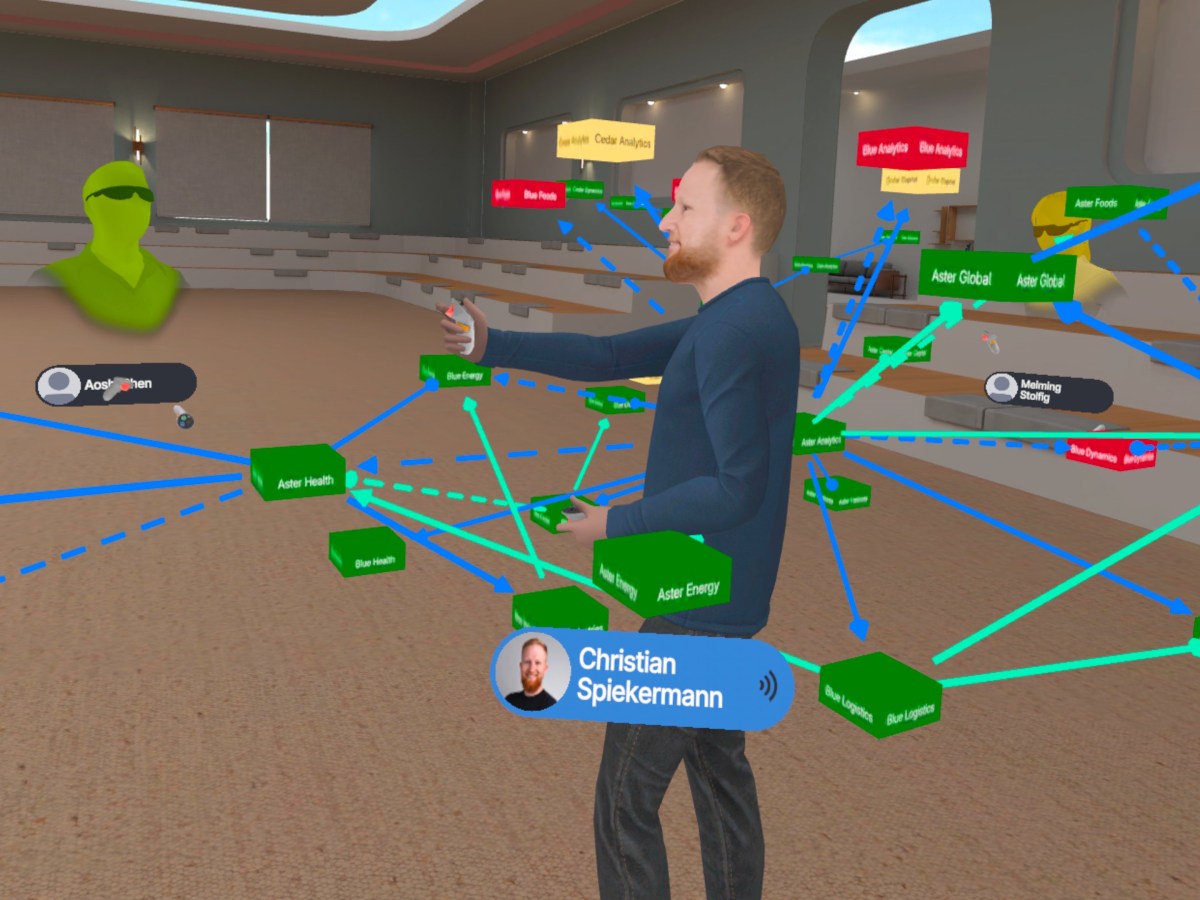
That change in perspective is fundamental. In a conventional presentation, participants usually share the same screen or look at the same slide. In an immersive environment, they can share the same object. They can move around it, observe it from different perspectives and discuss it while remaining spatially connected with one another. The financial model becomes part of the meeting itself.
This became particularly evident with the first example presented at the IFF: a three-dimensional interest-rate model, described as a “yield mountain.” On a conventional chart, the yield curve is essentially a line. In the virtual environment, it becomes a walkable surface. Maturities form one axis, the development over time another, while interest-rate levels become the third dimension. Participants can move along the model and see where the structure becomes steeper, where it changes direction and where unusual developments emerge.
The report emphasizes that crises, wars and anomalies can be visualized through changes in interest rates. The spatial representation therefore becomes more than a technical gimmick. It can serve as an additional factor in understanding financial developments. Instead of merely reading a curve, participants can experience its structure spatially.
The second example was a country credit-risk analysis. Sovereign credit assessments depend heavily on comparison and context. In the virtual environment, these relationships can be represented spatially: countries can become landscapes, rating levels can be represented through height and distance, and changes can be shown as movement rather than simply as entries in a table.
The IFF therefore points toward a new form of financial visualization. Data does not simply become larger or more visually attractive. It becomes spatial. Participants can enter a model and examine it from different perspectives. Complex relationships can potentially be explored collectively rather than simply explained from a presentation screen.
At the same time, the IFF does not reduce the idea of a finance forum to data visualization. One of its most important references is the networking culture of the European Finance Forum. Arthur provides so-called audio zones, small acoustic spaces distributed throughout the virtual environment. By entering one of these zones, participants can have a private conversation with one or two other people, similar to stepping aside at a physical conference to have a quiet discussion.
This is particularly important because networking is not an accessory to a finance forum. It is part of its substance. The IFF demonstrates that even this informal element of professional events can be translated into an immersive environment. Participants can move through the virtual space, join a group discussion, step into a smaller conversation and then return to the larger gathering.
The first IFF also demonstrated that the virtual environment can become a working space rather than merely a meeting place. During an interactive session, participants jointly collected ideas for future formats on a virtual whiteboard. Within minutes, the group produced an organized overview showing areas of agreement, different perspectives and a concrete agenda proposal. The altii report notes that something that might take an hour in a conventional workshop emerged here “almost in passing.”
This points toward an interesting combination of immersive communication, collaborative tools and artificial intelligence. Future IFF sessions could potentially combine expert presentations with spatial data models, group discussions, collaborative whiteboards and AI-supported moderation. The virtual environment itself becomes part of the methodology.
The premiere should therefore be understood less as a finished product than as a demonstration of a new type of financial event. The IFF is scheduled to meet regularly on the second Tuesday of each month, with future sessions focusing on specific topics and presentations. The aim is to turn the initial experiment into a recurring forum and, ultimately, into a community.
The connection with the European Finance Forum is central to this development. The EFF provides the organizational and social model: a recurring platform for financial expertise, exchange and networking. The IFF adds a new spatial dimension. Participants no longer have to be in the same physical location, while the virtual environment can offer forms of interaction that are difficult to reproduce in a conventional video conference.
This perspective is also reflected in the experience report by Aoshi Chen following the first IFF meeting. Chen writes: “My experience at the first iFF meeting exceeded my expectations.” More importantly, he concludes that “an immersive meeting does not have to be merely a digital copy of a real meeting.” This is perhaps the most important principle for the future development of the IFF.
Chen identifies several possibilities that go beyond conventional virtual meetings. Participants can overcome geographical distance and meet in a shared virtual environment regardless of their physical location. Virtual rooms could also become interconnected, allowing one environment to lead into another and potentially connecting real and virtual spaces.
Another possibility is what Chen calls the “borderless scaling of macro and micro.” Immersive environments can represent both very large and very small dimensions, allowing users to move from an entire landscape or room into the smallest structures of an object or biological process. Applied to finance, this could mean moving from a global market landscape into the details of a particular country, company, financial instrument or transaction.
Chen also describes the possibility of experiencing the evolution of a space over time. A virtual environment could change, grow, transform or react to the activities of its visitors. “The space itself would become part of the event,” he writes. For the IFF, this opens up a particularly interesting future perspective: the venue itself could become an evolving representation of financial developments.
The first meeting also made clear that the success of an immersive finance forum depends on accessibility and reliability. Chen experienced difficulties with loading and orientation and suggested a short interactive tutorial for new users. He also emphasized that ease of first access should be given high priority because a lower technical barrier could lead to more participants over time.
These practical observations are important because the vision of immersive finance can only succeed if participation remains simple enough for a professional audience. The technology should enable the discussion rather than become an obstacle to it.
The conclusion of Chen’s report points directly toward the broader significance of the IFF. In his view, the long-term potential lies not in reproducing a physical event as accurately as possible, but in redefining “distances, spatial boundaries and ultimately the boundaries between space and time.”
That is also the promise suggested by the first IFF. The European Finance Forum provides the proven idea of bringing financial professionals together for knowledge exchange and networking. The Immersive Finance Forum adds the possibility of turning this meeting into a shared, programmable environment. Yield curves can become mountains, country ratings can become landscapes, networking can take place in spatial audio zones, and workshops can evolve into collaborative virtual spaces.
The altii headline therefore captures more than the novelty of putting on a VR headset. “Return on Investment You Can Touch” points to a broader shift in financial communication. Numbers, models and relationships can become things that participants explore together rather than merely things they look at. The premiere of the Immersive Finance Forum suggests that the future of finance events may not simply be digital or physical. It may be immersive — a space where financial knowledge, professional networking and new forms of collaboration meet.

















Leave a Reply